Thread #18431626

File: file.png (910.9 KB)
910.9 KB PNG
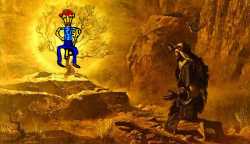
If you would die from beholding the full glory of God, why were men able to perceive Jesus without immediately dying, if he is supposed to be 100% God?
41 RepliesView Thread
 Showing all 41 replies.
>>
>>18431626
To be honest I think that the Resurrection is just made up. A bunch of traumatized disciples who witnessed their holy guide brutally die HAD to come up with something to cope. Jesus’s last words being “why have You forsaken me” would be too soul-crushing. It depresses me and I’m not even Christian
>>
>>
>>18431636
>>18431640
Yahweh betrayed even him
>>
>>
>>18431641
dont mention the name of god please. yhwh didnt betray him because first of all jesus was not even the messiah or anything he was schizo first century end times apocalyptic cult preacher. or second option just another rabbi. who knows. read gnosticism.
>>
>>
>>
File: Piss on yahweh.jpg (251.1 KB)

251.1 KB JPG
>>18431669
>>
>>
>>
>>18431626
>he is supposed to be 100% God?
The bible doesn't actually say that, its just head canon.
Actual plotholes in the bible are like when god sets an upper limit to the number of years man can live, then has several men not only live longer than that, but effectively live forever or when judas dies two different ways in two different gospels and does completely different things with the silver he got for his betrayal.
>>
>>
You die and are reborn again as a new bring with understanding
7 and then he said to his disciples, “Let us go back to Judea.”
8 “But Rabbi,” they said, “a short while ago the Jews there tried to stone you, and yet you are going back?”
9 Jesus answered, “Are there not twelve hours of daylight? Anyone who walks in the daytime will not stumble, for they see by this world’s light. 10 It is when a person walks at night that they stumble, for they have no light.”
11 After he had said this, he went on to tell them, “Our friend Lazarus has fallen asleep; but I am going there to wake him up.”
12 His disciples replied, “Lord, if he sleeps, he will get better.” 13 Jesus had been speaking of his death, but his disciples thought he meant natural sleep.
14 So then he told them plainly, “Lazarus is dead, 15 and for your sake I am glad I was not there, so that you may believe. But let us go to him.”
16 Then Thomas (also known as Didymus[a]) said to the rest of the disciples,
>“Let us also go, that we may die with him.”
>>
>>
>>
>>18431626
You can't behold the full glory of God because it is immaterial and invisible. There would always be a part of God not contained in the "glory" you saw visually or comprehended mentally with your finite mind. Moses seeing God's back is not literally seeing God's back because he doesn't have a back, but the back Moses saw was God's, both can be true. Jesus' human nature was and is corporeal and comprehensible to the senses, and he wouldn't be fully man if that wasn't the case, but he was also fully God. No contradiction
>>
>>
>>
File: 1740079232903060.jpg (20.9 KB)

20.9 KB JPG
>>18431626
The weirdest one to me is in Exodus
>Aaron's kids are priests, here is what they wear. Follow them, etc.
>Literally the next chapter, Aaron throws gold into a fire and makes a blasphemous idol of a bull
>No punishment, totally ignored
What?
Genesis is full of weird shit like giants, pretending your wife is your sister, lying for rewards, but I don't see them as internally inconsistent.
>>
>>
>>
>>18432589
Since psalm 22 is supposed to be a prophecy about Jesus' crucifixion, wouldn't it also be correct to say that psalm 22 is quoting Jesus? But then psalm 22 can't be used to explain why Jesus said what he said because the causality is reversed.
>>
>>
>>18432790
But Jesus is just as 100% God as God the father if you believe in the trinity. Unless you're some kind of heretic who thinks the son isn't equal to the father. In which case we'll have to tie you to a post and set you on fire.
>>
>>18432646
Here's some helpful context:
>The Priestly source (or simply P) is perhaps the most widely recognized of the sources underlying the Torah, both stylistically and theologically distinct from other material in it.[1] It is considered by most scholars as the latest of all sources, and "meant to be a kind of redactional layer to hold the entirety of the Pentateuch together,"[2] it includes a set of claims that are contradicted by non-Priestly passages and therefore uniquely characteristic: no sacrifice before the institution is ordained by Yahweh (God) at Sinai, the exalted status of Aaron and the priesthood, and the use of the divine title El Shaddai before God reveals his name to Moses, to name a few.[3]
>In general, the Priestly work is concerned with priestly matters – ritual law, the origins of shrines and rituals, and genealogies – all expressed in a formal, repetitive style.[4] It stresses the rules and rituals of worship, and the crucial role of priests,[5] expanding considerably on the role given to Aaron (all Levites are priests, but according to P only the descendants of Aaron were to be allowed to officiate in the inner sanctuary).[6]
>>
>>18432810
>Religion in monarchic Judah centred around ritual sacrifice in the Temple in Jerusalem. There, worship was in the hands of priests known as Zadokites, meaning that they traced their descent from an ancestor called Zadok, who, according to the Hebrew Bible, was the high priest appointed by Samuel. There was also a lower order of religious officials called Levites who were not permitted to perform sacrifices and were restricted to menial functions.
>While the Zadokites were the only priests in Jerusalem, there were other priests at other centres. One of the most important of these was a temple at Bethel, north of Jerusalem. Bethel, the centre of the "golden calf" cult, was one of the main religious centres of the Northern Kingdom of Israel and had royal support until it was destroyed by the Neo-Assyrian Empire in 721 BCE. Aaron was in some way associated with Bethel.
>In 587 BCE, the Neo-Babylonian Empire conquered Jerusalem and took most of the Zadokite priesthood into exile, leaving behind the Levites, who were too poor and marginalised to represent a threat to their interests. The temple at Bethel now assumed a major role in the religious life of the inhabitants of Judah, and the non-Zadokite priests, under the influence of the Aaronite priests of Bethel, began calling themselves "sons of Aaron" to distinguish themselves from the "sons of Zadok".
>>
>>18432811
>When the Zadokite priests returned from the Babylonian captivity after c. 538 BCE and began establishing the Second Temple, they came into conflict with the Levites. The Zadokites won the conflict but adopted the Aaronite name, whether as part of a compromise or to out-flank their opponents by co-opting their ancestor.
>The Zadokites simultaneously found themselves in conflict with the Levites, who objected to their subordinate position. The priests also won this battle, writing into the Priestly document stories such as the rebellion of Korah, which paints the challenge to priestly prerogative as unholy and unforgivable.
Exodus 32:21 Moses asked Aaron, “What did these people do to you that you encouraged them to commit such a serious sin?” [...]
25 Aaron had let the people get out of control, and they became an object of ridicule to their enemies. When Moses saw this, 26 he stood at the entrance to the camp and said, “If you’re on Yahweh’s side, come over here to me!” Then all the Levites gathered around him.
27 He said to them, “This is what Yahweh Elohim of Israel says: Each of you put on your sword. Go back and forth from one end of the camp to the other, and kill your relatives, friends, and neighbors.”
28 The Levites did what Moses told them, and that day about 3,000 people died.
29 Moses said, “Today you are ordained as Yahweh’s priests. God gave you a blessing today because each of you fought with your own sons and brothers.” [...]
35 So Yahweh killed people because they had Aaron make the calf.
>>
>>18432813
Compare Numbers 16
1 Korah (son of Izhar), Dathan and Abiram (sons of Eliab), and On (son of Peleth) dared to challenge Moses. (Korah was a descendant of Kohath and Levi. Dathan, Abiram, and On were descendants of Reuben.) 2 These four men were joined by 250 Israelite men, well-known leaders of the community, chosen by the assembly. 3 They came together to confront Moses and Aaron and said to them, “You’ve gone far enough! Everyone in the whole community is holy, and Yahweh is among them. Why do you set yourselves above Yahweh’s assembly?”
4 As soon as Moses heard this, he bowed with his face touching the ground. 5 Then he said to Korah and all his followers, “In the morning Yahweh will show who belongs to him, who is holy, and who it is that he will allow to come near him. Only the person Yahweh chooses will be allowed to come near him. 6 Korah, you and all your followers must do this tomorrow: Take incense burners, 7 and put burning coals and incense in them in Yahweh’s presence. Then Yahweh will choose the man who is holy. You’ve gone far enough!”
8 Moses also said to Korah, “Listen, you Levites! 9 Isn’t it enough for you that the Elohim of Israel has separated you from the rest of the community of Israel? Yahweh has brought you near himself to do the work for his tent and stand in front of the community to serve them. 10 He has brought you and all the other Levites near himself, but now you demand to be priests. 11 So you and all your followers have joined forces against Yahweh! Who is Aaron that you should complain about him?”
>>
>>18432819
16 Moses said to Korah, “Tomorrow you and all your followers must come into Yahweh’s presence. Aaron will also be there with you. 17 Each man will take his incense burner and put incense in it. They will offer all 250 incense burners to Yahweh. Then you and Aaron offer your incense burners.”
18 So each man took his incense burner, put burning coals and incense in it, and stood with Moses and Aaron at the entrance to the tent of meeting. 19 When Korah had gathered all his followers—those who opposed Moses and Aaron—at the entrance to the tent of meeting, the glory of Yahweh appeared to the whole group.
20 Yahweh said to Moses and Aaron, 21 “Move away from these men, and I’ll destroy them in an instant.”
[...]
28 Moses said, “This is how you will know that Yahweh sent me to do all these things and that it wasn’t my idea: 29 If these men die like all other people—if they die a natural death—then Yahweh hasn’t sent me. 30 But if Yahweh does something totally new—if the ground opens up, swallows them and everything that belongs to them, and they go down alive to their graves—then you’ll know that these men have treated Yahweh with contempt.”
31 As soon as he had finished saying all this, the ground under them split, 32 and the earth opened up to swallow them, their families, the followers of Korah, and all their property. 33 They went down alive to their graves with everything that belonged to them. The ground covered them, and so they disappeared from the assembly.
>>
>>18432646
The old testament is a huge pile of rewrites and propaganda amassed over hundreds of years all trying to tie whatever was going on in Jerusalem at the time to ancient history. Some parts of it are much older than others and come from a time when the people worshipped yawheh as a part of a pantheon of caananite deities, when yawheh was worshipped quite differently. The push to ban hilltop shrines in order to give the Jerusalem temple more central authority is something that you can see a lot. I don't know how conclusive I find it, but there are scholars who think that the calf was used as a symbol of yahweh or used in yahweh worship at an earlier period and effort was made to rewrite those practices as taboo.
>>
>>
>>
>>18432771
>>18432778
That's not doublethink or reading something into the text that isn't there. The Bible says that both You can't look at God and live and that Moses saw God's back. The mystery that we're talking about also applies to the creative process, how could God make us independent beings who genuinely have our own independent personalities while also knowing everything about us and being the reason for everything existing? The very nature of religious experience is that you recognize that it is unrecognizable to you and yet you're seeing it at the same time. How would the author of a book allow his characters who he knows everything about and is the source of their conditional mental existence to recognize him?
>>
>>
>>18432917
i.e. you can't "live" looking at God because the extent to which God is outside of your experience as a man is incomprehensible. But if he is all powerful he can show himself even if he is incomprehensible, although his essence cannot be comprehended. Both things can absolutely be true assuming an all powerful God
>>
File: images (20).jpg (80.7 KB)

80.7 KB JPG
>>18432920
>t. seething cut trunk
Your God is so impotent he's contained in reality? lmao
>>
>>
File: 30617.png (265.1 KB)

265.1 KB PNG
>>18431678
BASED.
>>
>>18431626
Jesus came down in human form, the Word became flesh.
>>18431774
The explanation I've heard for the verses on Judas' fate was that he hung himself on a tree with a branch hanging over a cliff or mountainside, branch breaks and Judas is spattered all over the land. Pretty morbid, understandable why the Bible wouldn't want to go into full detail on that.
>>