Thread #65065934

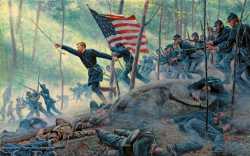
Were bayonet charges seen as foolish by 1863?
I get that it's a risky manoeuvre in any situation but they issued those things for years.
70 RepliesView Thread
 Showing all 70 replies.
>>
>>
>>65065934
>Were bayonet charges seen as foolish by the Russo-Japanese War
>Were bayonet charges seen as foolish by the time of the Great War
>Were bayonet charges seen as foolish in Milne Bay, the Battle of the Tenaru, the Battle for Henderson Field, or...
You already know the answer. Why make this thread?
>>
>>
They were always a risky finishing strike, and the risk became greater as advancing technology increased rates of fire. Either the enemy breaks and you get to kill them as they route, or they don't and your assault force gets badly chewed up.
>>
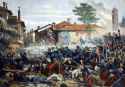
File: Battle of Solferino.jpg (275.4 KB)
275.4 KB JPG
>>65065934
No. Just a handful of years before the ACW, the French army decisively beat the Austrians in the Second Italian Independence War and they did it on the back on their bayonet focused shock tactics. The Austrians spent the war trying to use infantry fire based tactics, but were routed in almost every battle. The pre-war American Army (and so both the American and Rebel armies during the war) were organized along French lines. At that point in history, the only countries really basing their infantry around fire tactics were the British and Prussians (Austrians ditched it for shock tactics after their loss). Everyone else based tactics around the mass attack with bayonets.
The failure of those tactics in the American Civil War was due to abysmal training, poor leadership, bad morale among the troops and officers. Like at Pickett's Charge, the basic plan was there to create the conditions for a decisive bayonet attack. However it was organized poorly, then the preparations were half done, and finally it was executed poorly and wouldn't have been able to be exploited. So, it led to a bunch of men walking face first into an enemy gun line.
>>
>>
>>65065934
the doctrine was that a bayonet charge if properly supported and executed would force the enemy to yield their position or to break. since history had shown that when you carry out a bayonet charge the enemy was far more likely not to take it.
men would stand and shoot at each other for as long as they have ammo before breaking
but if you present them with a bayonet charge they'll brake ergo the bayonet charge was the "humane" way of doing things.
the problem being that you'd need to support that charge with skirmishers, tying down the flanks of the unit you are charging, artillery to soften them up ect.
during the US civil war both sides held to this doctrine/tactics. however due to most of their armies being made up from raw recruits they struggled to pull it of. often the charging unit would stop and fire at close range. this would however leave them open not just to the return fire of the unit it was charging but to fire from it's flanks.
as time went on fire became more deadly making a bayonet charge harder to execute successfully leading to the slaughter of WWI.
>>
>>65066003
>however due to most of their armies being made up from raw recruits they struggled to pull it of. often the charging unit would stop and fire at close range.
I like this kind of detail. I know raw/veterancy is something that's talked up but not always certain what the consequences are.
So like I know that the Union army struggled to make complex manoeuvres with raw recruits early in the war.
>>
File: rs=w_600,h_800,cg_true.png (865.5 KB)

865.5 KB PNG
>>65066003
>>65065999
Both of you watch Paper Cartridges, right?
https://www.youtube.com/watch?v=InvjDwDMCeI
>>
>>
>>65066013
If you want another fun fact about how badly trained ACW troops were, then you should know that both sides had so little marksmanship training that units with modern rifles had the same effective range as units still armed with smoothbore muskets.
>>
>>
File: AusUnserHeerUm1900-scaled-e1737303224985.jpg (179 KB)
179 KB JPG
>>65066035
>well he can't fucking miss can he
He might.
>>
>>
>>65066030
Yeah I like that.
I know also that the fire-by-rank thing is not as effective as it sounds because once the second rank crouches to reload they might not stand up again, if they aren't sufficiently drilled.
>>
>>65066061
also if the front rank loads while the rear rank shoots, all the moving around by the front rank might get in the way for the rear rank
to my understanding it was more typical to fire by platoon rather than rank
>>
File: The Rifle-Musket did not really influence the Civil War, 5.56 vs 58-cal rifle musket 300 yard sight setting and bullet trajectory - YouTube.png (529.9 KB)

529.9 KB PNG
>>65066056
Well going by paper catridges video then it is due to the incredibly unforgiving ballistics of the rifled musket. If you set your sight on the wrong setting then you are going to miss everytime you fire at long range targets. The actual effective range of both the smoothbore and rifle musket in the hand of the typical conscript or volunteer is 100-150 yards since within that range you can just point and shoot and have good chance of hitting anywhere on a human sized target. And even then the hit rate was still very poor due human aiming error and other battlefield conditions. Only at very close range like 30 yards or "Don’t Fire Till You See the Whites of Their Eyes" do you gain 100% hit rate.
https://youtu.be/UUmeV1e8aJQ?t=1178
The only way to exploit the long range advantage of the rifled musket is to have your men hit the firing range and practice shooting at long range targets and get better at range estimation. And that will become very expensive the more men you have in your army so usually only specialied sharpshooter units had the actual knowledge in how to exploit the rifled muskets advantage. As far as I know only the bongs spent the time and money in training everyone in marskmanship with the rifled musket.
>>
>>65065999
>The failure of those tactics in the American Civil War
They didn't fail. The rebel yell is as famous as it was because it often accompanied concealed mass infantry assaults, like at Chancellorsville and Chicamagua. The issue was that generals didn't always set themselves up to exploit the success of an infantry shock attack, see Stones River, Spotsylvania Courthouse, Gettysburg day 1.
>>
>>
>>65066543
>The rebel yell is as famous as it was
It was famous amongst rebels, not the people that you claim were culturally impacted by it. It's mostly just another CSA myth that southerners made up to make themselves feel better about badly losing the Civil War.
>>
>>
>>
File: 1747161871607343.jpg (99.8 KB)

99.8 KB JPG
>>65066018
yes, but I'm also a Kriegspiel/German unification autist, my dad is also a pretty big Napoleonboo.
the tism runs in the family and it's honestly a miracle none of us have trooned out.
>>
>>65067134
One where their military accomplishments gave them leverage at a truce table to partially achieve their war goals, rather than the war ending by waves of unconditional surrenders and full capitulation and the mercy and benevolence of the victors the only limit on the terms of the peace.
>>
>>65065934
Anon, how about you get a bunch of angry bearded men less than a football field distance away from you to charge you with sharpened steel when you can maybe scrape 3 rounds a minute, come back to us with your answer?
>>
>>65067124
Nah I've read Ambrose Bierce's memoirs. The fight against revisionism has come full curcle to the point where now the side that won is making the retarded claims. Reminds me of Vietnam war apologists who claim the US never suffered a tactial/stratetic defeat throughout the war.
>>
>>
>>65069259
The reasoning for a bayonet charge was basicallly a step by step process of going down from worst to least worst options.
Stand and get shelled by artillery is the worst. Maybe you need to do this to counter cavalry.
Getting into a short range exhange of musketry is the next worst, it is not decisive but produces casualties at a rapid rate.
Then we get something that only really appears towards mid-19th century, long range volley fire. It means few casualties, but uses up lots of ammo. It is also not decisive.
Then we get to the bayonet charge. It will cause casualties like a short range exchange of musketry, but it will be decisive and thus end the bloodshed.
This was generally accepted truth in the first half of the 19th century i.e. postnapoleonic period, though the closer we get to the 1860s the more cracks appear. The Austrians learned several times that firepower had become too heavy to actually push through a charge, and the Prussians first codified the idea that it was possiblle to win decisively through fire superiority in a short range firefight without needing a bayonet charge.
At the same time, longer range accuracy also increased, by 1866 volley fire by well trained troops was deemed 'accurate' out to something like 900 meters in various French manuals, and by the Austrians and Bavarians too.
The ACW is really the odd one out in this context, it basically fell back to tech and tactics more than 50 years old. The reasons, of course, are logistics and production, but I guess that is why the European observers were often appalled. They had probably seen better technology in action a few years earlier in Italy, or observed better trained British troops fuck up some Indians.
>>
File: 1537639023957.jpg (476.3 KB)

476.3 KB JPG
>>65065934
It was difficult to rally your troops for a bayonet charge unless it was absolutely necessary. If your troops could shoot it out instead, they'd much rather do that. The sharp stick is mankind's oldest weapon, and convincing someone, or yourself, to dive upon a sharp stick is exceptionally difficult for a human to do. Try it yourself, affix a sharp stick to a wall and run towards it-- your deepest instincts will nix the idea before you even start running, even if you don't intent to land on it. I'd say that most of the bayonet charges that occurred were seen as a necessity in an absolutely desperate situation. If anything, I'd wager the more poorly thought-out and foolish bayonet charges that occurred probably happened very early in the war.
>>
File: russian team building exercise.webm (3.4 MB)

3.4 MB WEBM
The only form of decisive action that a body of infantry - be they 21st century American or 1st century Roman - is capable of carrying out unsupported is closing with and destroying the enemy in close combat. Even with modern small arms the fight isn't really over until you've stepped over the other guy's corpse.
Hand weapons were just the first - and remain, ultimately, the final - tool used to do it with. What we do with semi or automatic rifle fire today was done with blades before self-loading firearms became the norm.
>>
>>
>>65069782
The fighting ranges in teh ACW were extremely short, often under 30 yards with buck and ball from smoothbore muskets not being uncommon.
This is one of the factors that puzzled European observers, they had long since accepted that if you got that close you must charge.
Though in 1866 there was at lest one battle when tehAustrians put this to the test and pusehd a charge through into a Prussian line, won the melee and the battle but ended up with so many casualties from Prussian fire that they were unable to advance further or fight another battle, so clearly firepower was going up in lethatlity.
>>
>>65066003
one of the things that also made bayonet charges riskier in the civil war was the minie ball, which pushed the effective engagement range of a line company out much farther than musket balls out of a smoothbore.
If it takes about 20 seconds to reload a musket (or a muzzle loading rifle) from a trained and drilled section, then you can run somewhere between 60 and 100 yards before they can shoot again. If the engagement ranges are 100 to 200 yards, this is pretty doable. If the effective engagement ranges are 200 to 400 yards, this is a whole lot harder.
(they had rifles for hundreds of years before then, but it takes longer than 20 seconds to force a full sized ball down a rifled barrel, the minie ball didn't take much longer than a regular sub-caliber musket ball because it was also sub caliber on the way in, but not the way out)
>>
>>65069911
I'd argue the killzone did not actually increase in range appreciably relative to the smoothbore era because of how silly the trajectory is past a point.
Rather the existence of sights and the mechanical accuracy increase made the old killzone (50-150yds) much deadlier overall.
>>
>>65069911
By the 1850s the French and Austrians were using muzzle-loading rifles and trained companies could fire 3 rounds per minute out to around 700m, with enough accuracy to hit an enemy formation or column.
This obviously required training for officers and NCOs to estimate ranges, for troops to set sights and correctly manage the reloading (which as you said was still more complicated than loading a smoothbore)
>>
>>65069259
>>65069506
>aiming is a myth and 99% of soldiers shot their weapons into the sky
S.L.A. Marshall's numbers have been confirmed utter ass-pulls for decades but pseuds love parroting them like they're fucking gospel
>>
>>
>>
File: Lewis_Millett_saluting_1985.jpg (993.2 KB)

993.2 KB JPG
>>65070735
https://en.wikipedia.org/wiki/Lewis_Millett#Korean_War
>>
>>
File: Anne is amused.jpg (96.4 KB)

96.4 KB JPG
>>65070775
>gets his balls blown off so badly that he was considered the last fatality of the Civil War when he died in 1914
Looks like Johnny Reb's bullet found its mark after all
>>
File: My_Lai_massacre_woman_and_children.jpg (261.3 KB)

261.3 KB JPG
>>65070513
The willingness of Americans to outright massacre civilians with regularity in Vietnam (often at point blank range) pretty solidly debunks whatever notions Marshall espoused that the US soldier was somehow a soft-hearted faggot who was too much of a pussy to kill.
>>
>>
>>65069259
>I don't think a lot of guys were aiming/trying to actually kill people.
You have to be a genuine retard to believe this myth. It's obvious both sides had poor marksmanship training and refused to provide follow-up training to make up for what was a foundational/institutional failure
>>
>>65065999
>pickett's charge
That was doomed to failure regardless. The Rebs were enfiladed by Union arty, had to march a long distance in the hot sun through knee high vegetation and impeded by farm fences. The Union held the high ground and can see everything unfolding. Longstreet was right.
>>
>>
>>65065968
https://www.youtube.com/watch?v=gvjOG5gboFU
And then they got a face full of the bullets from the Spencer Repeating Rifle, like during the Battle of Griswoldville.
>>
>>
File: 1715601313796596.png (704.8 KB)
704.8 KB PNG
>>65070880
Marshall couldn't have predicted My Lai but he could have looked at the brutal desensitized combat from before he wrote the book like THE ENTIRE FUCKING PACIFIC THEATRE or Korea.
One Korean war ancedote that sticks to me is retreating British infantry riding on a Centurion fighting a chinese soldier who climbed on their tank tooth and claw and hearing the noise of other chinese going under the tracks. A tanker in that unit repeated in an interview matter of factly how he was given a shit detail of cleaning bits of mangled chink gristle out of the running wheels before they made another run up Gloucester Hill.
>>
>>65070880
>with regularity
>it's literally just that one village
KYS
>>65073308
>PACIFIC THEATRE
"driver, tracks, infantry" has been a part of tank combat since September 1939, retard
>>
>>
>>65073616
>the only reason why some battles had lots of troops involved but only a few casualties is because the shooters were aiming badly
>there's no other reason at all, absolutely none
so your dad kept fucking your mum but she only shat out you (and who knows how many siblings you have) because he was aiming really badly and kept going up her arse, is that the conclusion?
>>
>>
>>
The American Civil War generally used charges to force a surrender on an overextended unit that couldn't fight effectively anymore. It was usually suicide to charge an enemy with ammo. The Maine charge was a calculated gamble on the Southern forces being depleted.
>>
>>
>>
>>65066439
>As far as I know only the bongs spent the time and money in training everyone in marskmanship with the rifled musket.
Checks out. The other major army of the time that was fire-centric was the Prussians, and their approach was (simplified) to give everyone a Needle Gun, roll up to those 150 yards and then just start blasting away with rates of fire that'd overwhelm an opposing line of muzzleloaders.
>>
>>
>>65069894
>>65072870
And entire culture at that point that could be summarized as "why don't you just shoot them?".
the whole bayonet charge thing only works if the other idiots play along and dont just fucking shoot.
>>
If there's a clear numerical advantage or the battle has clearly been one, troops really don't feel like getting shot to clear out the ten remaining enemies, and this can lead to thousands of men dallying, as they say, pretending to fight rather then actually seizing a position.
Soldiers often just don't want to fight, for various reasons. Either they think the war is almost over, they don't think their manuvour serves any purpose, they don't particularly dislike the enemy, they don't want to win if that would mean being redeployed somewhere shittier, maybe they think that one enemy soldier is just funny panicking shooting at the air, or is a kid.
So the only way to end the battle is that everyone is ordered to afix bayonets and walk towards the enemy, so they can't avoid ending that engagement.
While it's not strictly the reason bayonets are issued, there are both tactical, doctrine and psychological elements, what historically they called morale
>>
Also emphasise, the strongly underrated element of monkey behaviour.
When people are scared, really scared, adrenaline, monkey behaviour. Large numbers of men might flee, or start using their rifles as clubs, the whole thing can very quickly devolve into hooting and hand to hand combat. My experience is that soldiers will often manage that in other ways but only these are only marginally more sensible. One guys digging a hole to China, one is packing mags in a huge pile, one is giving redundant orders over and over. One guy is laying down suppressive fire. They're panicking. Stone cold killers are very, very rare. Usually you try to keep your troops calm, rely on them doing the important things before they panic and nothing especially stupid afterwards.
The bayonete gives men a monkey reason to hold their position, to repel a monkey tier attack instead of running away.
Because I've lived to see someone just go full ape and charge the enemy with a machete screaming incoherently, and 20 armed men just drop their guns and try to run away, throw rocks, climb trees, and our guy killed precisely zero of them he just scared the crap out of them. It took us almost half an hour to calm him down and get the machete off him and he barely remembered anything that happened. It was ridiculous, deeply concerning, heroic, I don't know. But he had a machete and these guys only had automatic rifles, which when held like clubs were not convincing weapons. The monkey value of an m16 is very low. You can't throw it, it's not a good club. If you're too scared to reload, fumble mags, can't find ammo, your rifle is now a club, you are now a monkey, and our monkey had a machete and made scary noises.
>>
>>
>>65079472
>monkey brain
This is ultimately it, and why USMC and Bongs were using them in Iraq and Afghan.
Monkey brain does not need to be told to be scared of pointy metal. That doesn't really work with guns in the same way. Monkey brain also scared of lots of angry men, so ultra effective in the era of musketry.
>>
>>
>>
File: 14234123412.jpg (283.3 KB)
283.3 KB JPG
>>65080754
>>65080601
>>
>>
>>
>>65080776
BTW I HIGHLY recommend playing War of Rights video game
.
You will feel with your GUTS g why do bayonets sucks and shooting rules. You will understand dynamics why do people standing 100 feet apart prefer to reload their musket instead of charging with the bayonet ,.
Really play this fucking game.