Thread #65075680

File: A-12_Avenger_II_concept_art.jpg (1.1 MB)

1.1 MB JPG
Could it have been completed if they kept throwing money at it or was a lost hope? Would it have been any good?
25 RepliesView Thread
 Showing all 25 replies.
>>
>>65075680
Anything can be completed if you throw enough money at it.
>Would it have been any good?
Probably not. The age of the dedicated attack aircraft ended in the 70s and the limitations of a carrier air wing makes the versatility of multi-roles even more valuable.
>>
>>
>>65075680
If I recall correctly one of the major problems was an absolute US-fucking-Navy classic: make late changes to the requirements they wanted way after the design had been locked down, which then led to cascading issues. Clients who do this deserve to be shot. F-35 shows that ultimately if a design is sound enough the real savings comes from just buying in bulk. If you cancel a program the whole thing is fucking wasted, or if you cancel after a small buy the price per plane is high, whereas if you just commit to pumping the bastards out then even a high program cost can get amortized. Avenger's cost seems almost quaint by the standards of what came after.
At the same time, it must be said that McDonnell Douglas was having big corporate management issues by the late-80s/early-90s. So I don't know if they could have brought anything ambitious over the finish line as they were. They infected Boeing with it after the merger and look what happened there.
May Jack Welch burn in the deepest pits of hell.
>>
>>
>>
>>
File: A-6F_1987_DN-SC-88-00704.jpg (1.8 MB)

1.8 MB JPG
>>65075841
Correct, Grumman had come up with picrel (non-afterburning F/A-18 F404s) and the Pentagon stealth mafia tried taking a different tack with Dorito, result was USN ended up with the Stupid Hornet
>>
>>65075993
His management theories spread beyond his immediate reach and more or less fucked most worthwhile American companies. They are a template for looting the value out of companies and leaving only hollow rent seeking behind.
>>
File: R (32).jpg (62.8 KB)

62.8 KB JPG
The F-18L could have stood a chance if Northrop had made a demonstrator.
>>
>>65077195
>F-18L
See:
https://desuarchive.org/k/thread/65024548/#q65044403
>>
File: SR (5).jpg (239.7 KB)

239.7 KB JPG
>>
>>
File: va-yf12a-04-cr-12.jpg (639.5 KB)
639.5 KB JPG
>>65077310
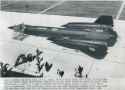
It was the Air Force's interceptor variant of the Central Intelligence Agency's A-12 photographic overflight spyplane. Announced in early 1964 by president Johnson, later that year officially displayed at Edwards Air Force Base.
(SR-71 multisensor USAF reconnaissance platform came along two full years after the YF-12 interceptor project. First SR-71 prototype flew in December 1964, same day as the first mated flight of the M-21/D-21 hypersonic drone carrier.)
>>
>>
>>
>>
>>
>>
>>65078525
>only existed because
Wrong.
Air Force had a long range interceptor requirement in 1960 (after cancellation of the XF-108), an RB-12 bomber version for SAC was also studied. USAF was in contract discussions completely separately with Lockheed/Skunk Works about their aircraft requirements; CIA was Skunk Works' main client for the A-12.
>acknowledged
Yes three separate aircraft were under development as of 1963, two of them for the Air Force. The SR-71 evolved as a two seat lengthened fuselage higher gross weight multisensor version of the RB-12/R-12 studies. (An earlier 1962 concept of Kelly Johnson himself for a "universal A-12" that could be field-modified for different missions wouldn't proceed because of the divergent SAC-USAF and CIA requirements.) By 1963 also, the large magnitude cost of the CIA's A-12 program had begun to draw attention of gov budget oversight and momentum grew for the Air Force's version of the reconnaissance aircraft to take long term precedence, in other words the CIA having their own costly (that would in a couple years anyway be obsoleted by low Earth orbit satellite capability, as would the SR-71 upon its entry into service) Mach 3 reconnaissance airplane in tandem with the USAF's separate different-mission version wouldn't be each tolerated or funded over the long term.
>>
>CIA flights
The A-12 didn't begin operational service with CIA on spyflight missions until 1966, it had a protracted full three years of test flight and systems development from 1963 to 1965.
A-12 didn't even fly at Mach 2+ to triplesonic until mid-1963 because the J58 engine wasn't available until that year; its maiden flight April 30, 1962 was with J75 powerplants. First actual flight with a J58 mounted in one nacelle only was October 5, 1962 and first flight with two J58s in each nacelle was January 15, 1963; it took most of that year to even get the brand new engine to operate properly, not to mention aerodynamic problems with the airplane, stability, nacelle inlets etc. at speeds above Mach 2. Several crashes occurred and all of the years 1963 and 1964 were spent in risky flight test development, not until 1965 did the A-12 program begin to appear 'ready' for operational service in its design photographic overflight mission.
>>
>>
>>

>>65078586
>loiter time
True but is it an important characteristic for a long range interdiction/strike aircraft that needs to hit and get out quickly? Payload, I doubt it would have exceeded the A-6 which was extremely capable; a major loss to the USN's carrier air wing.
>>
>>
>>65078622
checked, agreed but what's the point? Not all of the USN carrier air wing long range strike aircraft's missions are going to be against land targets. Stealth isn't the solution/answer to everything, or the maximization of capability.
>defense against SAMs
>displace
Speed and maneuverability remain critical for any aircraft. Not a tradeoff characteristic
>ahead of its time
In concept (for a naval air wing) perhaps. Because it was never built/flight tested we'll never know
>if you get detected
That's a function of time. Low level flight non-stealth aircraft are perfectly capable of 'being detected' at the last minute, neutralizing the target, and getting tfo effectively.