Thread #16958748

Pykrete + evaporative or earth air heat exchanger Anonymous 04/15/26(Wed)07:12:13 No.16958748 [Reply]▶
File: 1775115088154.jpg (18.6 KB)
18.6 KB JPG
I want to make a small warehouse for famers who have 1-2 acres of land. Specifically farmers in India and Africa. Im not smart but i did some research and it seems to me that my idea should work.
I want to put pykrete(ice with sawdust or mud which lasts 5-6 days in room temp) in a big evaporative cooler and cool a small 250-300 sqft warehouse which will be built onsite.
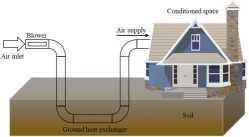
Another method i was curious about was putting pykrete inside an earth air heat exchanger for more cooling.
Nearly 40% of fresh produce gets wasted due to non availability of warehousing for farmers worldwide.
Please smart anons of /sci/ run the numbers and tell me if im on the right track or should i rethink this from the start or should i hire an engineer off fiverr or something to build a prototype.
Thank you for your time.
7 RepliesView Thread
 Showing all 7 replies.
>>
>>16958748
The reason pykrete takes so long to melt is that it has low thermal conductivity. It acts like an insulator.
In other words: the exact properties that make this material appear attractive for cold storage render it effectively useless for the task.
There's no free lunch in thermodynamics. If it takes longer for a substance to melt, it is cooling the surrounding environment less for that time.
You'd be better off encouraging these people to utilize alternative means of preservation. Canning, curing, fermenting, etc. are all fine and profitable options to drastically increase shelf life and reduce spoilage.
>>
>>
>>16958748
Do some geological research for the ground temperature at different depths.
You're probably better off building a root cellar for "cool" and insulating a large freezer and trying to be energy efficient with good door discipline.
>pykrete
Sourced and maintained how?
TL:DR
Earthen covered warehouse "root cellar" which probably needs humidity control, but passively cooled by the ground temperature. The root cellar is insulated at the roof and entrance, but the floor isn't insulating as it maintains contact with the deeper cool soil. Subsoil temperature is climate dependent and needs to be researched.
Insulated freezer that is designed for efficiency to minimize losses so a smaller refrigeration unit (solar powered?) can maintain a freezing temperature.
>>
>>
>>16958748
Solar panel with AC unit will be much cheaper and way more practical for remote rural locations in Africa and India than trying to ship in expensive ice from somewhere else. There's lot more effective solutions too like food preservation in other forms than cooled warehouses or just swapping crops for better climate appropriate plants.
>>
Don't forget that your solution needs to be simple and cheap enough for them to maintain and duplicate after you leave. You don't want to repeat the well building of Africa where as soon as the volunteers leave the locals harvest the project for scrap to sell for pennies. You also probably want an individual to have a direct ownership of your food storage area and have a financial incentive to continue to use it. Whether that's a farmer who stores their stock, the person that runs the market or some other distributor or seller. You want a lasting system that fits within their culture and power structure.