Thread #18370883

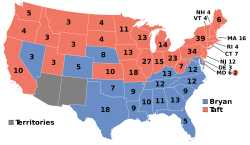
File: 1908 presidential election.png (364.9 KB)
364.9 KB PNG
After his triumphant victory in 1904, Theodore Roosevelt rashly declared that he counted the three years of McKinley's term he'd served as a full one and thus he would honor the two-term tradition by not running again in 1908 ("I would cut my own hand off to take back that promise" he remarked later). Although TR would not be a candidate for president, he was also not adverse to grooming his successor in William Taft, a conservative lawyer and judge from Ohio who had served as the first American governor of the Philippines. TR smoothly engineered Taft's nomination at the RNC in Chicago in June--it was widely joked that "Taft" was an acronym for "Take Advice From Teddy."
The Democrats held their convention in Denver in July. After having failed with a conservative candidate four years earlier, they dusted off William Jennings Bryan for another go. Bryan finally abandoned his silver fixation and instead ran on a progressive, pro-labor message--he had since learned that some appeal to Northeastern voters and an audience outside the Midwestern farm belt was necessary. Bryan remarked sarcastically that Roosevelt had stolen many of his ideas, and as the originator, he was logically the person to be carrying them out.
32 RepliesView Thread
 Showing all 32 replies.
>>
File: 05020003d12w.jpg (426 KB)

426 KB JPG
The general election was not an exciting one. Taft abandoned the GOP's traditional support of civil rights in the hope of trying to score votes from the Solid South, which had been alienated by Roosevelt's admission of Booker T. Washington to the White House in 1904--this election is said by some historians to be the point where black voters began to doubt the party of Lincoln for the first time. The country had been enjoying prosperity since McKinley's administration outside a short-lived panic in 1907 and most voters saw no reason to reject the GOP or the amicable Taft ("Everyone loves a fat man" remarked one pundit). Furthermore, Bryan's loser stigma from his prior presidential attempts was hard to overcome.
On Election Day Taft was elected easily with 321 electoral votes to Bryan's 162 and 51% of the popular vote to 43%. Bryan won only the South, two border states, and three Western states. Newly-admitted Oklahoma also gave him its 7 electoral votes--the Sooner State was much more Democrat and Southern-aligned in its early decades of statehood than it would be post-World War II.
William Jennings Bryan was finished as a presidential candidate. But he still had the affection of millions of Democrat voters who had cast their ballots for him three times and his ideas were becoming more mainstream by 1908. He remarked once that he was the only man who could govern the country in defeat.
>>
>>
>>
>>18370885
>>18370883
imagine running the same guy for president 3x because they had nothing else
>>
>>
>>
>>18370883
>>18370885
WJB's worst election in popular vote percentage although he improved on his electoral college tally from 1900. Oddly civil rights leaders F.L. McGhee and W.E.B. DuBois both endorsed him over Taft.
>>
>>
>>
>>18371627
The Palmetto State was a totally un-democratic banana republic that essentially limited voting to the upper classes of the state which meant blacks and poor whites were excluded from the franchise. North Carolina was not as bad and did have a wider franchise so some Republican support did exist there throughout the Jim Crow era.
>>
>>
Al Smith, a Catholic New Yorker who supported repealing Prohibition won 91% of SC's votes in 1928 merely for having a D next to his name. And that was the lowest showing the Democrat presidential candidate had gotten there since 1896.
>>
>>18370885
>>18370883
What happens if Bryan wins this one?
>>
>>
>>
>>18371647
Absolutely he would. For one thing, TR was a staunch party man who believed the Democrat Party was bad for the country and should not be in charge of it. Second, many Republicans would conclude they need him to win, and pressure him to run in 1912. Third he just liked being president, and was generally dissatisfied with administrations he wasn't in charge of. If he wasn't satisfied by Wilson's presidency, he definitely won't be by Bryan's, who he probably disagreed with more.
>>
He’s more progressive than Taft.
If he won re-election in '12, he might have kept us out of WW1, since he thought Wilson was too Anglophile while he was Secretary of State.
But if he loses re-election in '12, presumably to Teddy, I don’t really see how that would cause us to enter WWI later. Actually that would probably mean that Teddy would bring us into WW1 in 1914 or '15.
>>
>>
>>
>>18371683
As he said, some civil rights leaders endorsed Bryan, who also endorsed women's suffrage. Yes, the Scopes Monkey Trial was stupid and was a bad way to go out but that aside...
Also don't forget that Taft thought the best way to improve race relations was doing nothing and later as Chief Justice upheld school segregation and restrictive housing covenants.
>>
>>
>>
>>18371696
Since he'd served all but six months of McKinley's term he considered himself a two term president and said he wouldn't run again, although he came to sorely regret that decision. He was only 50 when he left office, still young and bursting with energy and found his post-presidential life a drag.
>>
>>
>>
File: Sensible Chuckle.gif (1.1 MB)

1.1 MB GIF
>>18371620
>>
>>18371725
MN governor John Johnson was considered as one possibility, if only because Northern Democrat governors were scarce enough during 1897-12 that literally any one that cropped up was considered presidential timber. But there weren't a lot of other options.
The New York World ran several editorials in early 1908 suggesting 16 possible Democrat candidates. To those who said Bryan's time had arrived, the Post sarcastically challenged its readers to name one state he lost in 1896 that he had a chance of taking in 1908. The articles proved why there were no other realistic choices; most of the 16 candidates the World listed were too old, too obscure, too conservative, too Southern, or else Bryan supporters unlikely to challenge him (ironically one of the candidates on the list was Princeton president Woodrow Wilson). However, the World also seemed to think Johnson was a real possibility.
>>
>>
>>18371762
Unfortunately the writer of the articles (David Sarasohn) didn't actually name names except for Johnson and Wilson, only saying they were too old/Southern/obscure/conservative/Bryan groupies unwilling to challenge him. Incidentally, Pulitzer allowed George Harvey to write an anonymous editorial in favor of Wilson as one of the possibiities, indicating how conservative both Harvey and Wilson were in 1908 (Harvey would remain so):
In here he said the party must run a candidate who supported sober, centrist ideas and disavow populism or radicalism. A candidate who would regulate corporations and control their more abusive practices but disavow socialism or nationalizing industries or infrastructure, and who would support a passive, non-imperialist foreign policy.
>>
>>
Bryan's accomplishments are quite unusual, as he came from a small rural and strongly Republican state and lost all three of his presidential runs. His legacy lives on in some of the policies he has pursued in his political career, including the 8-hour workday, direct elections for U.S. senators, and gradual income tax. As for his political career, he gained national notoriety for his attack on the gold standard and his relentless promotion of free silver and politics for the good of the average American.