Thread #25116589

File: IMG_0859.jpg (41.7 KB)
41.7 KB JPG
Does anyone over the age of 5 believe in Pascal’s Wager? This has to be up there with unmoved mover and the problem of evil.
42 RepliesView Thread
 Showing all 42 replies.
>>
>>
no
People got on fine without god and the only people who are so hopelessly lost that they need to cling to some obfuscated metaphysical representation of an underlying/overarching force are the blind, the foolish, the cowards, and the forlorn. Civilization did fine before the abrahamic god and will do fine long after this god is forgotten. The idea that "well just because there's no proof doesn't mean we shouldn't believe" is the same mental illness that makes men think they're women, vice versa, or leads people to believe Hegel was right about anything.
>>
>>
>>25116600
>the god they worshiped is the same god Pascal refers to
Yes, religion has always been the metaphysical port in the storm. This won't change until our biology can transmit more pure truths about the nature of our life. Until then, it's all cope under the guise of the things humans need for survival: purpose, community, and refuge
>>
Many people worship God or believe in Him out of fear. Many children, at a young age, are introduced to the word of God through fear-based teachings. So yes, some believers pray daily to an unseen, all-knowing being in the sky, hoping that He won’t punish them or ruin their lives.
>>
>>
>>25116589
You have to think about with the logic of a gambler. Imagine it like this. All the evidence against God's existence is one side of the table. But it's obvious to everyone at the table that believing in God is a sure bet. If you could do that same scenario for money over and over again all day and make a trillion dollars you'd be the happiest person on Earth. You'd literally be jumping up and down, rolling all over the floor, running through the house. Everything would look sparkly and twinkly from pure happiness. That's basically what the evidence against God is like. You piece all the cards together one by one and then look at the board. It wouldn't matter what the cards are if it's obvious betting on the God side is going to give you profit every time
>>
>>25116589
https://en.wikipedia.org/wiki/Pascal%27s_mugging
>>
>>
>>25116624
>https://en.wikipedia.org/wiki/Pascal%27s_mugging
so THIS is how the Jews do it?
>>
File: D768DACC-AF8A-46BE-B38D-07BAD4D09319.jpg (34.3 KB)

34.3 KB JPG
What if god is a fedora tipping atheist and only allows redditors into heaven
>>
>>
>>25116589
>problem of evil
That's still devastating to christcuckery. They had to make up excuses that aren't even in the book, to pretend like it's not.
Free Will and Gen 3 causing all evil, neither are in the book.
>>
>>
>>
>>
>>
>>
>>
>>
>>
>>
>>
>>
>>
>>
>>25116596
All people everywhere throughout all of time have believed in divinity. Civilisations were started through joint worship. (you) and all the other spiritually disabled retards of modern times are the loud minority in history.
>>
>>
>>25116589
>muh wager
Why post in /lit/ when you clearly haven't read Pascal? Go back to /sci/ with the rest of calculating funko-pop-buying manchildren there that can give the precise refutations of the Wager you happen to search here.
>>
File: pascal's wager.png (260.2 KB)

260.2 KB PNG
>>25116589
https://benthams.substack.com/p/pascals-wager-is-a-good-argument
>Let’s say your credence in Christianity is one in thirty-thousand. This seems pretty absurdly low—you should generally have a non-trivial credence in any view believed by a sizeable share of the smartest people who ever lived. Suppose that conditional on Christianity, you think the odds are 10% that believing it will increase your eternal reward. This still means that being a Christian has infinite expected value. It increases the odds of eternal reward by one in 300,000.
>Presumably it would be worth performing some action if it gave you a 1/300,000 chance of infinite reward. If by working on reducing nuclear risks, you could lower the odds of the end of the world by one in 300,000, then that would seem like a valuable career, even if atheism is true. By conservative estimates, wagering on the right religion is better.
>>
>>25116589
It's not as if you can choose what you believe anyway. Either you find a premise credible, or you don't.
If there really is an omniscient God, then he surely knows the difference between true credence and hedging.
>>
>>
>>
>>25116589
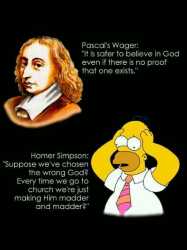
There are three distinct problems with Pascal's Wager, and the one identified by Homer is by far the least problematic:
1. The fact that it's a false-dichotomy - This is the one identified here, and is pretty easily solved. There are only four religions large enough to be worth taking seriously on numbers alone: Christianity, Islam, Hinduism, and Buddhism. The latter two believe in reincarnation, so if you don't pick them, and they're right, then you get essentially infinite do-overs. Of the remaining two, Islam teaches that Christians can go to heaven, whereas Christianity teaches that Muslims go to hell, so unless you already are (or have at some point been) a Muslim, Christianity is objectively your safest bet.
2. The issue of sincerity - Pascal's Wager really only works as an argument for performing a belief in God, and if that performance is insincere, then every major religion argues that it doesn't count.
3. The issue of Cost - The "wager" in Pascal's Wager is that by believing in God, you risk nothing from being proven wrong, but if you disbelieve, then you risk much, but the argument that belief in God costs nothing is demonstrably false. Every religion demands many sacrifices of its members, many of which are demonstrably antithetical to 'the good life' in a Godless universe.
>>
Pascal's wager makes more sense if you use it as a frame to evaluate empirical arguments for christianity like historical jesus, unexplainable accuracy of biblical predictions, the apparition miracle in portugal, the tests that found perfectly preserved blood cells inside a 600 year old skull relic.
If you just have pascal's wager and nothing else then yeah it's trivially cancelled out by equal possibilities of anti-god and alternative god but if you give any of the aformentioned empirical arguments any credence and then combine them with pascal's wager it makes more sense.
>>
>>25116589
Just read the pensées. It's a short book and the "wager" is a small portion.
>>25116611
>This won't change until our biology can transmit more pure truths about the nature of our life. Until then, it's all cope under the guise of the things humans need for survival: purpose, community, and refuge
Is you saying that "it's all cope" a "pure truth"?
>>
>>25120239
>for performing a belief in God, and if that performance is insincere, then every major religion argues that it doesn't count.
God is rationally discoverable. As long as you don't worship contradiction like atheists then it's logically self-evident. >Why is there something and not nothing?
>THERE IS NO GOD. OKAY? I'M GOING TO MASTURBATE AS MUCH AS I WANT.
>Erm, okay, but why is the-
>THERE JUST ISN'T. FLYING SPAGHETTI MONSTER AND UNICORN IN THE STARS. I AM ENLIGHTENED. E=MC2.
>But don't yo-
>WHY IS THERE EVIL IF ISAAC NEWTON EXISTED? HE WAS SUPER DUPER SMART AND NOW WE HAVE COMPUTER. CHECKMATE CHRISTKEK
>No, but how can something exist at al-
>GOD IS FAKE. IT'S A FAIRYTALE
>>
>>25120526
>God is rationally discoverable.
I disagree, but even if that statement were correct, it would have absolutely no bearing on the validity of Pascal's Wager, as an argument for belief in God. The assertion that the wager serves only as a valid argument for feigning belief in God (provided we exist in a universe where the question of whether God exists is truly unanswerable) remains valid.
>As long as you don't worship contradiction like atheists then it's logically self-evident
I find the reference to "contradiction" here baffling, as nothing in the argument you make afterwards involves God's nonexistence as contradictory.
As for the argument itself, I'll ignore the cartoonish, 2010-ass caricature of a stereotypical Nu-Atheist, and stick to the points right at the beginning and end, where you actually say something worth responding to:
>Why is there something and not nothing?
>How can something exist at al-
This is the 'Argument of First Cause' first popularized by Thomas Aquinas, and then redelivered, with considerable polish, by Descartes, and there are two fundamental problems with it:
1. It views 'existence' vs. 'non-existence' as a spectrum, rather than a binary, insisting that things can be 'more substantial/perfect/real' vs. 'less substantial/perfect/real'.
2. It requires the idea of 'causality' as inherently applicable to every natural process, and that this is an idea that we can assert a priori.
The second point was mostly discredited by Hume, when he rightly demonstrated that 'cause and effect' is not something we can inherently discern from the existence of linear-time (which Descartes asserted it was, with no argument to back that claim up), and was completely discredited by later empirical discoveries in Quantum Mechanics, which show that classical notions of causality don't always actually apply in nature, once you observe things on a small enough scale.
The former point is the larger issue, though. Even if we accept that the existence of the universe requires some explanation, filling that gap with 'God' only makes sense if we accept point-one as valid. As Carl Sagan put it "If God created himself, why not skip a step, and say that the universe created itself? If God has always existed, then why not skip a step, and say that the universe has always existed?" The Aquinas/Decartes answer to that question is that a thing which is in some way defective or deficient cannot cause itself to exist; nor can it sustain itself indefinitely, and that a thing which is 'more perfect' cannot be created by a thing which is 'less perfect', thus an infinitely perfect, infinitely non-defective entity must exist, ergo: God.
>>
>>25120526
>>25120563
Cont.
This argument completely falls apart when one considers that:
1. What makes something 'perfect' vs. 'defective' is entirely subjective. Descartes himself gives the example that a bird without wings would be defective, whereas a mountain without wings wouldn't, because wings on a mountain serve no purpose, but this is rooted in overly teleological thinking. The argument only makes sense if you start with the unjustified assumption that everything which exists exists to serve an end, rather than arising organically. In brief, you need to *start* already believing in a divine plan for this defintion of perfection to make any sense.
2. Even if we accept that Descartes' definition of perfection is valid, his claim that something less perfect cannot create something more perfect is rendered invalid through empirical observations. He obviously lived pre-Darwin, but within the framework provided by evolutionary science, his own example of wings-on-a-bird is a great example of 'more perfect' creature arising through an entirely organic process from a 'less perfect' creator (i.e., its ancestors).
>>
>>
>>
>>25120563
>>25120566
Just read Pensées. This is not how Pascal thinks.