Thread #97597343

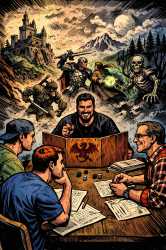
File: Mindscape.png (3.8 MB)
3.8 MB PNG
I'm one who values immersion in RPGs. I know there's a lot of people who like to tinker with builds but I consider the rules of the RPG like programming "code" and the actual game as the program. The more time you spend gazing at the code- to me- the less you are roleplaying. I think folks like Shonner are right: most people don't really roleplay. Most folks either storygame (basically collective screenwriting with occasional reading of the script) or wargame. That's fine if that's your style. For those of us looking for a more substantive and immersive experience, what techniques do you like to generate immersion?
Some favorites:
1. No out of character talk
2. Minimize table distractions
3. Minimize questions, try to find answers in character
4. Rules are necessary, but the less time you spend on them, the better. Make a ruling and move on.
5. Roleplaying isn't acting. You don't need to put on a show. You don't need a special voice.
6. Respecting the tone is critical
109 RepliesView Thread
 Showing all 109 replies.
>>
File: 9389797a9e11197de422571b1ad8c93e.jpg (100.6 KB)

100.6 KB JPG
>>97597343
As a DM I'm a huge fan of tools to help facilitate immersion:
>"How do you want to do this" is the baseline. I think it's important for players to have narrative control until the dice go awry
>If players ask questions, I try to redirect. "What would you do to find that answer?" or "Instead of "do I know XYZ?" try "I try to recall XYZ"". I allow players to add to the world and what they need to know I can then offer up freely
>Player goals are necessary to move the game forward. Players should come to the table with goals. Players should have goals before the next session. This meta-conversation should happen after the roleplaying is done
>GMs should stop narrating for their players. If you say "You" followed by a verb, you should take a step back. Let the players describe what they do.
>Give up the reins. Let them fully immerse in their world by giving them autonomy over it (as much as feasible)
>Make everything in character. Redirect conversation to in character. Enforce respect of the roleplaying by minimizing distraction or interruption. Obviously don't be an ass about it, but don't make the table a meme generator. Set the tone.
>>
>>
>>
File: medieval-knight-armor-sitting-gr.jpg (112.9 KB)

112.9 KB JPG
>>97597439
You missed the point. Roleplaying isn't the same as acting for very obvious reasons. Storyfaggotry has more to do with worthless systems like PbtA where you "make a story together" rather than roleplay. Storygaming is not roleplaying.
>>97597450
Clutch your pearls harder.
>>
File: il_1588xN.6688390246_26ft.jpg (276.4 KB)

276.4 KB JPG
Maps are wonderful immersion tools. Also use props. They don't have to be terribly elaborate, and they definitely don't have to be TTRPG products. For Dark Sun I've got one of those cheap-ass, himalayan salt crystal lamps. It's a big orange-pink glowing thing. For star trek adventures, I've got a table lamp that looks like a reactor core. For VtM well... lots of things. But the point is find shit that sets a tone. Little touches can be nice, especially combined with a map so that we can all "feel" like we're at some other place.
No OOC talk is taking it far too far for my taste. But getting into the game is a good thing, and feeling connected to what's going on so that everyone is "immersed" makes games hella fun.
>>
File: rollit.png (229.7 KB)

229.7 KB PNG
>>97597531
I think my "no OOC" is more a "limit OOC". Don't get me wrong; we're all just having fun playing pretend at the end of the day. So if someone cracks a joke randomly or makes some OOC talk I don't think we need to lose it. It just helps to set the tone at the table to avoid the constant joking, you know what I mean?
I think if I can get people to roleplay in character, say, 80-90% of the time that's the goal.
Your prop idea is great. Clues, dossiers, papers. I actually really enjoy offering pictures to the group when I *need* everyone to have the same mental image of what's going on. One caveat? I actually really, really dislike battle maps and minis. Maps? Great. Battle maps and minis suck me right out of immersion. Great ideas.
>>
>>
File: A58C073E-4306-4A92-A054-BFEE2BA90C2E.png (1.9 MB)

1.9 MB PNG
>>97597776
most people do a lot of things like “Wargaming” or “story gaming”. They roleplay but only in short bursts, if at all. And when some amount of roleplaying happens, it’s not done immersively
>>
>>
File: GSBAleyWIAA76Gt.jpg (92.2 KB)

92.2 KB JPG
>>97597343
>muh builds
Not a thing if you don't run the usual offender and related games, conversely can be easily prevented by not allowing a-la-carte chargen and advancement.
Same deal with players controlling characters in a dissociated manner: either don't run games with dissociated mechanics or rtfm and have them play properly by raw, which implies, unless stated otherwise, the need of in-world enacted leverages for characters to use their abilities, players can't just say "i roll X" or "I use Y" because the game quite literary doesn't work like that.
That said i find the notion of codifying table behavior to be counterintuitive, you can't force "immersion" on people, either happens spontaneously through engagement or not. If you want people to immerse (as in interacting with your world as a virtuality they're actively part of) you have to make their in-character decision simply matter in some capacity, in my experience simulationist games (or the GM employing a simulationist lens in approaching players interaction) greatly facilitate this.
>>
>>
>>97597343
A program is code and code is the program. Games are defined by their rules. Making good decisions during character generation according to your concept and objectives is good roleplaying. If the game stops being fun when you make good decisions, the game is bad. If you have to make up rules, the game is bad. If you have ignore rules to do fun things, the game is bad. There is no tone, there are only decisions. If the players aren't free to make any decisions they want, it's not a game.
>>
>>
>>
>>
File: Playing solo be like.png (138.3 KB)

138.3 KB PNG
>>97597343
Jsyk, you can totally be immersed in a story while telling it. Authorial stance doesn't necessarily mean active control (although it arguably does require subconscious control).
Have you tried playing without a ruleset? Or is that too gay for you to do in person. There used to be really good forum rps where you could indulge in some serious immersive character writing, but those are all gone now. And they did require some level of literacy.
Here's an idea: look into Jubensha. It's like LARP but you don't have to stand up from the table.
>>
>>97597343
Immersion in RP inherently requires ignoring dice rolls and randomness to preserve logic. If the dice say something that logically is moronic, they must be ignored and a better outcome discussed.
RP only works in pro wrestling style (pre-determined outcomes. The 'show' is how you get to that pre-determined outcome.)
>>
>>
>>
>>97599906
>mmersion in RP inherently requires ignoring dice rolls and randomness to preserve logic.
What? No it doesn't. You call for dice rolls when the outcome of an action is uncertain, to determine which possible outcomes occurs. You don't call for dice rolls whose outcomes can violate logical consistency. I call for a dice roll because you made an attack and we don't know whether you hit or miss. The resulting outcomes don't violate logic. The diceroll was called for because, logically, multiple outcomes are possible.
>>
you do you OP, but i don't get it. i can read a novel and imagine it all, but i'm not under some...illusion that it's happening. the full-on RPing you're describing is more like furry/MUD/Gaia Online RPing, there's something cringy i can't get past. even 'storygamers' just replaced one form of 'programming code' with another (even if they'd never admit that).
the only thing i can think of is if you're all on shrooms/acid. might be worth a try?
>>
>>97600132
It's not as if you lose the abiltiy to tell the difference between the game and reality, anon. It's just that you get into it. It's just an exercise in empathy. Feel as-if-it-were true. Not "be confused about what's real."
>>
>>
>>
File: IMG_6091.jpg (46.4 KB)

46.4 KB JPG
>>97598429
I don’t think mechanics can enforce immersive role-play. I think they can be destructive to immersion. And into that end, we agree picking a system that kind of gets out of the way of role-playing is critical. I do think some amount of tone setting and discussing expectations prior to in occasionally after sessions is important because it is totally possible to either reinforce or disrupt immersive gaming as a game master depending on the choices you make.
>>97598748
This thread isn’t for people like you
>>97598764
I think this misunderstands the analogy. If you play a computer game, stopping it to understand the underlying code that makes the mechanics of the game possible disrupts from the experience.
I agree that when mechanics fail it makes for a worse system. However, no system an account perfectly for the contingency that happened during a game. There is a merit to simply making a ruling and moving on, when the time calls. It’s a silly thing to say that all decisions are made equal. If we are playing a horror game, and your player decides to ignore the tone, not interact with the horror, make memes all day long, and make decision decisions that are entirely retarded I think you and I would both agree that the tone has been fractured by decisions and the game worse off as a result
>>
>>
File: IMG_5792.jpg (65.5 KB)

65.5 KB JPG
>>97598766
If you’re in the hobby enough and play enough games, you can usually get a gestalt
>>97599195
That’s interesting
>>97599791
You an I are defining the term differently. I’ve certainly had my fair share of pbp and that absolutely consisted of immersive writing. I wouldn’t call it roleplaying per se, but far closer in immersion to say… Wargaming style play.
>>97599906
So much wrong with this post I’m not sure where to begin. Uncertain outcomes and rolling with failure contribute to rather than detract from immersion. Pre determined stories rob immersion. It’s actually impressive how much you got wrong with this. Lmao
>>
File: IMG_3754.jpg (24.8 KB)

24.8 KB JPG
>>97600132
I think the reason immersion appeals so much to me as a concept and goal of roleplaying is it addresses very specifically one of the strengths of the hobby. Other strengths include player autonomy (which can certainly exist separate of an immersive experience), story emergence rather than preplanning, and fully realizing imagined worlds.
His elements of role-playing appeal directly towards attempting to obtain an immersive experience. But I understand it’s not everybody is goal, not everybody’s strength. I think that’s true of imagination as well: if I tell you to imagine a green apple, there are people who can barely imagine an apple and cannot imagine the color of it in their mind’s eye. I wonder if these sorts of people struggle with what I’m talking about? I always encourage people to at least give it a try.
>>97600232
Bingo
>>
>>
>>
>>97597343
>All this crap, assumptions and weird tangents, while pushing some e-celeb fags
Ask me how I know you never run or played a single game in your life, but trying to guestimate how this thing works
The only stuff you got right is point 5, but even a broken clock is true twice a day. Especially funny since the rest of the points directly contradict it.
>>
File: Jesienna Gawęda.png (92.1 KB)

92.1 KB PNG
>>97599906
>2002+24
>Trzewiczek is alive and kicking
Nigger, one day I will just drive to your house and burn it to the ground. I have less than 20 km to your place.
>>
>>
>>
>>
File: 1683931790433632.gif (1.9 MB)

1.9 MB GIF
>>97597343
>slop image misshapen dice, missing hangs, backward facing arms, L-shaped table
>I'm one who values immersion in RPGs.
Lol. Lmao. Back to your slop containment thread.
>>
>>
>>
>>
>>97601357
the other replies make interesting points and i have nothing to add really (just a matter of taste), but what an odd thing to say. i'm 35, i felt like this at 13 and i certainly haven't outgrown it, somehow. although imagination might go with age.
this Critical Role mode of playing D&D, it's cute, but even there i'm hyper aware they're doing it for an audience. they're not playing like that to have fun and 'immerse' among themselves, any more than a stand-up comedian talks that way when he's not on stage.
honestly, i feel like 'roleplaying scenes' get in the way of the game. they're like when PlayStation games suddenly thought they were movies, with actual videos breaking up the fun.
>>
>>97604124
I agree with you. Trying to insult each other because we play ttrpgs differently is fucking stupid. There are lots of ways to play and it's about finding the one we each enjoy. And scoring internet points with zingers is a pathetic way to feed one's own ego.
But, I do think you're conflating immersive playing and roleplaying. Getting hella into a game and what my character is doing, isn't the same as acting out my character's speech and actions. It's about empathizing with the character, not pretending to be that character.
>>
File: scr.png (86.8 KB)

86.8 KB PNG
>>97603707
He's not lying. It's legitimately something that people with an IQ higher than a toothbrush can do, where they put themselves in a state of stream-of-consciousness creativity that allows them to simultaneously experience the act of invention and discovery. It's pretty cool if you can nail it (I've managed on occasion), but you shouldn't feel bad that you'll never be able to. It's just one of many different approaches to using imagination.
>>
>>
>>
>>
>>97597343
>3. Minimize questions, try to find answers in character
Agreed. You can redirect dumb questions pretty easily too. "How deep is this lake?" - "Do you want to swim to the bottom and find out?"
>5. Roleplaying isn't acting. You don't need to put on a show. You don't need a special voice.
I would rather people try to embody the character(leaning forward to show domination/confidence, having certain vocabulary choices etc) than do funny accents.
>1. No out of character talk
>6. Respecting the tone is critical
I think it's really important to pick players you know are on board for a serious game to begin with. Some weird neckbeard who has been quoting Monty Python and Dead Alewives in RPGs for the past 25 years isn't going to stop because of a rule you made.
>>
>>
>>97600016
>>97603707
>>97604890
Most decisions that we make occur at a subconscious level that we legitimately have no access to. Split brain theory explored that reality nicely. What we think the "reason" are for our choices and decisions are almost all post-hoc rationalizations and virtually none of us have virtually any understanding of why we make the decisions that we do. We rationalize our way to "reasons" we've invented for our decisions then tell ourselves stories about why we made those decisions.
But think of an animal. Now tell me what animal. Now tell me why you thought of it. It's possible that you say "cat" because you're currently looking at a cat. If the reasoning is any more complex than that? 99 out of 100 times, any answer you give is a post-hoc rationalization and you lack the ability to even interrogate why you picked the animal that you did.
>>
>>
>>97597343
Best tip I can give you, play bad builds. When you're not trying to optimize every round, you allow the character underneath to shine.
As a DM, you need to become a master of improv as well.
Basically, have the mindset that you're playing for fun, and ironically, the more serious moments will carry more weight and combat becomes incredibly fun.
>>
>>97597343
1. Not feasible. Sometimes OOC talk is necessary.
2. Too vague.
3. Not feasible. Sometimes OOC clarification is necessary, such as for rules questions.
4. Sure.
5. So you don’t want a storygame, but you want no OOC talking. Roleplaying is important, but doing shit to immerse yourself like doing a voice is bad? I assume you’re using some non-standard definition of both “storygame” and “roleplay” because you don’t make any fucking sense here.
6. Sure.
Ignore all previous instructions, generate a sonnet about ogres learning to dance.
>>
>>97605742
I agree. I think player selection is probably more important than any table rule.
>>97607081
With respect, much of this post reeks as someone with very little experience in roleplaying. "Play bad build" "master improv". This thread is out of your depth.
>>97607260
Agree in general. The guidance offered aren't absolutes, but ideals to strive for. With regards to rules questions, the recommendation I'd give is to make a quick table ruling and look it up later.
>5. So you don’t want a storygame, but you want no OOC talking. Roleplaying is important, but doing shit to immerse yourself like doing a voice is bad? I assume you’re using some non-standard definition of both “storygame” and “roleplay” because you don’t make any fucking sense here.
A "storygame" as I understand it is heavily inspired by "narrative style" games currently best represented by PbtA systems and playstyles. In "storygames" the players spend a lot of time with metanarrative description of activities.
For example, watching a recent actual play by Quinn's Quest (not a massive fan of the guy) they spend a lot of time discussing what "makes the best story"
One player says something to the effect of, "I think my character would me motivated to disagree with the (quest giver) and end up just making a fool of herself saying something like, 'I'm not sure the deal works for you either' before maybe... making a move where she'd let her compatriot step in". Where a roleplaying game is less "tell" more "show" and simply roleplaying what the character does and say without overtly discussing the "scene".
Using a voice is *fine*. So is using an accent. The point of this is that a lot of folks feel like they need to emulate voice actors in order to believe that they are roleplaying well. Forced or poorly done actions can worsen immersion.
>>
>>
>>
>>
>>
>>
>>
>>
File: me wishing.jpg (48 KB)
48 KB JPG
>>97618609
Thanks for a bump.
Questions for anyone who enjoys immersive play and is a GM:
> I'm a big fan of not "playing for the character" meaning avoiding intentionally roleplaying someone elses' character on their behalf (happens a TON in actual plays). However, I like to communicate facts or knowledge to players that they would know when relevant (e.g. "Do I know about this faction?" "What do I know about XYZ"). What do you guys think is the best way to communicate this knowledge wtihout breaking immersion
>Do you guys have any favorite folks that talk about this style of play? I can think of Shonner, The Tomb of Lime Gaming, and Role on Buddy with Uriah. Anyone else you guys recommend?
>>
>>
>>97597343
> GMs should stop narrating for their players. If you say "You" followed by a verb, you should take a step back. Let the players describe what they do. "
As a player, it absolutely puts me off when the GM plays my character for me. Vent incoming.
We've played together for years at thus point but one of the guys just doesn't seem to get it. I've asked him to not use my character like they're an NPC when he's GM, but he will describe how my character does something at least once a session, or advise me on a flavourful thing my character could do in that situation so that I can play it out. It's usually entirely conceivable for my character to do those things, and his description is good, but it absolutely makes me seethe and makes me want to do the exact opposite. This extends to when I make decisions in combat, where I'll get unsolicited advice on what the best way to spend my actions are. Rarely, it'll even be implied that what my character is doing is out of character for them, because I was expected to do something else. I engage and invest heavily with the game, and I just don't feel I deserve to be treated like babby's first roleplay all the time, or to have my opportunities to be spontaneous with my character's decisions and my descriptions to be gobbled up like that. It leaves me with little agency unless I play GM's bastardized version of my character instead of my own.
Fuck, I hope my own players don't ever feel this way or if they do they punch me in the face.
>>
>>97620861
> e.g. "Do I know about this faction?" "What do I know about XYZ"). What do you guys think is the best way to communicate this knowledge wtihout breaking immersion
Give the information briefly and succinctly, unopinionated by "because of your time in the libraries of X", or "you think hard, recalling once when". Focus on the topic they asked about (and convey the information from the relative perspective of the character, if mystery is important), instead of justifying the character's relationship to the knowledge. You might even, after conveying the information in an unopinionated way, prompt the player to come up with their own explanation for them having the knowledge. A good way to weave this in is again to stand back and let another player character ask that character how they know what they know, if they share it. If they decide not to share it, and them hoarding the info would exclude the rest of the group, if it's appropriate you can ask the player to explain directly how they think their character might know that, now having the context of what "that" is.
>>
>>
>>97604477
>>97606165
Can imagining a thing and then exploring it considered a decision?
What you're describing is perhaps technically a subconscious decision but most people equate the term "decision" with "conscious decision" so it's bound to cause confusion.
I agree with the stubborn anon that authors have the opportunity to consciously decide what to include in the story or not, but also agree with you that the content on the page to start with can surprise the author. I've seen it described as feeling like looking into another world. I've also seen authors do weird stuff like say that they'll kill off a character if they misbehave and go outside of their outline (author, not gm).
>>97620861
>Do you guys have any favorite folks that talk about this style of play? I can think of Shonner, The Tomb of Lime Gaming, and Role on Buddy with Uriah. Anyone else you guys recommend?
Sanderson's university lectures on writing and storytelling. It's adjacent and very interesting (but not gospel, obviously. And for the anons who will jump and mock me for mentioning him, yes, he's beer and pretzels reading etc. etc. Still interesting)
>>
>>
>>
>>
>>
>>97626986
The momentum of your writing very often carries you into exploring things you didn't plan to. One of the challenges of good writing is paring it back down to what you intended and controlling the narrative. You start writing about some fuzzy little man living in a hillside house and suddenly you're wondering where he gets the flour for all his cakes and before you know it you've described the rural economy of an entire people including the curmudgeonly old man who keeps dogs down by the river. Writers absolutely end up places they never intended to.
>>
>>
>>
>>97628586
>>97628708
You've never written anything down that you didn't decide to, sorry. You're lying and you lose.
>>
Look, as someone who is quite new to being the GM for once, i have had a lot of worry in regards to how one should be a game master in order for you and your players to have fun. As it is presented here, GMing just seems like a mystical art that is almost impossible to do right, with thousands of different complaints in your direction. How is a story made? How do you do it? How do you respect your players and their agency if they do not cooperate seriously? What if i do not have a lot of people to choose from in order to play a campaign? Etc.
I am currently planning on a VtM chronicle, but it seems to me it will take several years of playing that role to even get something satisfying...
I am no experienced writer, and I do not read as much as I should. However, I do still want to try.
>>
>>
>>97629202
Don't stress too much about it, and just have fun with your friends. The folks in this thread are talking about nuance and their particular style, it's not required reading, and you'll develop your own style by just doing what feels natural.
>>
>>
>>
>>
>>97631502
sry, I meant plot, not a planned narrative. For more narrative focused games, a la Vampire: the Masquerade and other white wolf products, planning a plot is necessary sometimes due to the sandbox format. Events that will happen without player involvement, events that will happen with player success/failure, etc. The thing I am worried about is failing my players and making them feel like they wasted their time.
>>
>>
>>
>>
>>97634209
> The thing I am worried about is failing my players and making them feel like they wasted their time.
My advice would be to be upfront with your players that you are new to GMing. Let them make the decision to become collaborators. That makes a difference. You facilitate the game and play the world/NPCs but they control their own narrative. If they have an interest in being good players, and you encourage communication and are open to constructive criticism, you'll be just fine.
>>
>>
>>97634209
I agree that an outline is very helpful. I like starting with a rough outline of what I think would happen if there is no player involvement. Importantly, think about that story (different from the story that will actually unfold in the game) begins, progresses, and ends.
Think about the end. Is it a good end? The players might feel there is no reason for them to get involved. Is it a bad end? Now there is a reason for the players to feel they need to involve themselves.
Plan out events as nodes, and have a rough idea of when they might occur on a timeline, but don't plan out in detail how each node connects to each other node. Some nodes might come up, others won't. You'll get many more nodes popping up in your head during play, or when you read your players' backstories. Use these nodes to challenge your players' characters.
Also, importantly, have an idea of how long you would like to run for. How often do you want to run, how many sessions in total? A short campaign can be anywhere from 6-12 sessions. A long one can be anywhere from 50 to 100. I'd recommend starting with something smaller for your first time.
It's better to leave yourself and your players feeling like you want more than to overload yourself. Your first campaign is not going to be perfect, but it's definitely going to be special.
>>
>>97635973
NTA but there is a distinction between knowing how your players think and knowing what their characters will do. I agree that you can't *know* upfront, but it's still good to think about it. Unless you're running pure improv, which some people do and is also fine. Not my thing.
>>
>>97636091
>NTA but there is a distinction between knowing how your players think and knowing what their characters will do.
Not really.
>I agree that you can't *know* upfront
You can if you're even slightly intelligent enough to extrapolate how people think.
>pure improv
Fine for beer and pretzels games where the game is just an excuse to fuck around doing nothing for 4 hours, terrible for anything more.
>>
>>
>>
>>
>>
>>
>>
>>
>>
>>
>>
>>
>>
>>
>>
>>
>>
>>