Thread #25064706

File: G_cHtkIakAEWn7K.jpg (418 KB)

418 KB JPG
Ἀχαιῶν δερκόμεν' ὄσσε edition
>τὸ πρότερον νῆμα·
>>25006897
>Μέγα τὸ Ἑλληνιστί/Ῥωμαϊστί·
https://mega dot nz/folder/FHdXFZ4A#mWgaKv4SeG-2Rx7iMZ6EKw
>Mέγα τὸ ANE·
https://mega dot nz/folder/YfsmFRxA#pz58Q6aTDkwn9Ot6G68NRg
>Work in progress FAQ
https://rentry dot co/n8nrko
All Classical languages are welcome.
312 RepliesView Thread
 Showing all 312 replies.
>>
File: CLG_greek.jpg (3.2 MB)

3.2 MB JPG
>>
>>
File: CLG_Master_List.png (3.6 MB)

3.6 MB PNG
Wonder what the threadly category will be
>>
>>
>>
>>
File: 1705370004522029.jpg (373.6 KB)

373.6 KB JPG
>>25065006
>Epistola Christoferi Colom de insulis nuper repertis
>incole utriusque sexus nudi semper incedunt, quemadmodum eduntur in lucem, præter aliquas feminas, que folio frondeve aliqua aut bombicino velo pudenda operiunt, quod ipse sibi ad id negocii parant
oh god the images that flashed in my mind...
>>
>>
File: 1666375874684987.jpg (37.8 KB)

37.8 KB JPG
>>25065096
I might be biased but....yes, especially in the right mouth
>>
>>
>>
>>
>>
>>
>>
>>
>>
>>25064869
Roll
>>25065006
That’s not what I intended when I made the images; but I can see how saying “OP” would be taken as the thread OP. Kind of retarded of me in hindsight.
>>25065164
I’ve read the letter before specifically because of making these tables lol
>>
File: IMG_7072.jpg (1 MB)

1 MB JPG
Descartes ended up being shockingly readable. I think one thing post-classical Latin has going for it, as a second language for everyone using it, is that no one tries to flex by using obscure words, so it makes really advanced philosophy surprisingly accessible even if you can otherwise only read the easiest prose like the gospels.
English has this weird disease, originating from poor grammar education, where we intentionally utilize jargon to make our work less readable, to come off more impressive.
Which ascends to yet higher planes of absurdity when the illiterati, unskilled in their craft, include basic semantic errors in their purposely poor prose.
So you get ESL foreign attorneys writing gibberish that no one can read, and that the attorney hopes no one bothers to read anyways. On top of this, their writing still typically outstrips the average native lawyer.
Basically it means the lawyers all write like jargon-bots and the academics all write in a mix of jargon and platitudes, because none of them can write anyways.
I think I am years off from having enough of a grasp on grammar to really be able to consistently express my thoughts eloquently, but Latin has helped somewhat.
>>
File: 1769877947453344.jpg (419.2 KB)

419.2 KB JPG
>>25065987
idk maybe it's the pitch accent, when done properly
>>
File: 1770151697171632.png (14.6 KB)

14.6 KB PNG
>>25065158
ὁ Καικίλιός ἐστιν ἐν τῷ κήπῳ
>>
>>25065596
Not much if the translation is from Loeb’s and antiquated as fuck. Check out this sentence from Daphnis and Chloe for instance as taken by Sir George Thornley.
“Mytilene estin politeia Kai megales Kai Kalle.”
“ Mitylene is a City in Lesbos, and by ancient Titles of honour, it is the Great, and Fair Mitylene.”
>>
>>25065596
Loeb’s shills always say Loeb’s is perfect for learning Greek because they use literal translations so imagine my horror when the translation is some public domain crap from 1600 equivalent to Longus what Alexander Pope was to the Iliad. In retrospect I think I should’ve just read the penguin classics edition.
>>
>Polis esti tes Lesbou Mytilene megale Kai kale.
Here. I got home and this is the exact sentence as written down which has been rendered thus by Thornely. How is this not embarrassing to Loeb’s shills???? That’s like using Pope’s Iliad or Jowett’s Homer. Loeb’s is supposed to be the perfect teaching apparatus for newbies…
>>
Whelock's book quality is so low I cant read it, I'll try the epub version and if the formatation is not too messed up I'll continue, but in the case it sucks is there a similar book but with a proper digital format?
>>
>>
>>
File: 2026-02-04-191541_1799x596_scrot.png (206 KB)

206 KB PNG
>>25066945
huh?
>>
File: file.png (340.6 KB)

340.6 KB PNG
>>25066982
It sucks right? its not worth to make a philologist work this early, but idk maybe in a smaller screen it may look okayish
The epub version seems quite good contrary to my expectation
>>
>>
>>
>>
>>25066979
Yeah that is sound advice. I assume Loeb’s copies of more popular works are more up to standard ie Homer and Plato and similar that probably have more critical attention.
I just see no possible way for a student of Greek to find any use for a translation like this.
>>>Polis esti tes Lesbou Mytilene megale Kai kale.
>>> Mitylene is a City in Lesbos, and by ancient Titles of honour, it is the Great, and Fair Mitylene
How are you supposed to learn anything from a dual language edition like this? I feel like the money I spent was entirely wasted.
>>
>>
>>
>>
>>25067846
Classical Jamaican Patois Bombaclat on da ting
>>25067803
Yes I was quite disappointed in my copy of Bede when it arrived to find how nonliteral the translation is. I’ve gotten much more consistent value from parallels of the Douay-Rheims to the Vulgate because bible autists 400 years ago put a lot more autism into their literalism than classicists 100 years ago. Unfortunately that’s limited to a register that doesn’t really open up the golden age for me so I need to just keep grinding Roma Aeterna, a vocab list, and sharpening my formal grammar.
>>
File: LukeCowboy.jpg (45.9 KB)

45.9 KB JPG
>throws your grammar book in the trash
You're welcome.
>>
File: IMG_6763.png (1.5 MB)

1.5 MB PNG
>>25068986
This man’s straightforward presentation of input-oriented ideas has enabled me to read classical, medieval, and renaissance authors, many with relative ease, after about a year of 30 minutes with LLPSI a day and 30 minutes of other reading, while maintaining top grades in law school.
The reason his ideas and advice seem out there is because, firstly, he is an autodidact, and secondly, because he aims his advice at autodidacts.
Also he talks the retarded way he does because he talks like a good language teacher talks generally, i.e. overexaggerated, slow, clear.
At this point I believe his haters are largely academics that can’t handle the autodidact being popular, or autists that hate his voice, or both. He gets the most hate on discord, which tells you something.
It was really funny when he had that spat with the Orberg foid and other smaller degree-holding Latin YouTubers like found in antiquity were A-Logging him in the threads.
>>
>>
>>
>>
>>
>>25069239
Well, I wrote >>25069077, and I actually never used his audiobook because I wanted to focus on ecclesiastical pronunciation, so I used a totally different channel’s recordings.
>>
File: 1763920425496518.png (1.2 MB)

1.2 MB PNG
>>25066990
it's not amazing but unreadable? age porro
>>
>>
>>
>>
>>
File: 2026-02-06-143049_1314x924_scrot.png (270.8 KB)

270.8 KB PNG
n.b. Teubners, at least the ones I have, don't use the subscript iota convention, which I kinda like, it gives it a slightly more archaic feeling
>>
>>
>>
>>25070670
eh I mean it's also kinda up to you, ideally both, because we start with the Greeks, but anything medieval from the west will be in Latin
in antiquity ancient Greek kinda obviously mogs Romans and the latter basically knew it
>>
File: 1765570963384782.png (104.5 KB)

104.5 KB PNG
virtute praeco omnes in hoc filo
>>
>>
>>25070662
Well, of course it has its uses. I have a grammar book and I keep it for reference/explanation when I want to look something up. I’ve probably read every chapter of it at least once atp, it just never was my way of actually practicing my Latin, more like I would double check the pluperfect clause table in 2 minutes and then read for an hour. Also, when I want to get into output I intend on going back through the translation exercises as a refresher/review of all the concepts anyways so that I can be prepped to do Bradley’s Arnold.
>>
>>25070928
I saw this article by Charles E. Bennett (not for the first time) printed in the Memoria Press magazine/catalog.
>The question as to the educational worth of any study must always be a pertinent one. If Latin is not of fundamental importance in the high school curriculum, then large numbers of students are making a prodigious error in pursuing the subject, and the sooner we understand this, the better for our civilization.
https://www.memoriapress.com/articles/justification-for-latin/
>>
I just read beowulf and now I want to learn old English as fast as possible please God someone help me. Is it even possible to learn it without taking all my life also do they sell beowulf in its original on its own? No side by side.
>>
>>
>>25071104
Naturally, which is why it so dramatically fell from grace as the purpose of learning Latin shifted from, well, knowing Latin, to a humanistic mental discipline for training the mind by forcing yourself to memorize 2500 inflectional endings (I believe my source on this is Diederiche’s papers from the 30s on reading) before ever trying to read.
>>
>>25071121
Check the infographic in this post. >>25069077 Just grab something entry level from one of the paths, or from all three, that appeals to you, and just start marching down the chart. It’s the ancestral form of your own mother tongue, it will absolutely not take you your whole life, or even remotely as long as learning a close modern language like Spanish did.
>>
>>
>>
>>
>>
File: 1754490685105773.png (56.7 KB)

56.7 KB PNG
Translation challenge:
Easy
We're sending it soon.
Don't try to be a smartass.
Are the new slaves worth their price?
Medium
If my cousin does't find his beloved dog, he won't take that well at all.
The law stated that whoever killed a pig during the festival was to be fined heavily.
He kept asking himself if it had been better if he had never departed from his homeland.
Hard
During the eleventh year of the truce between the two city states the bastard scion of the old king, unhappy with the circumstances, devised a false-flag in such manner: leaving for the lands to the east with an excuse, he secretly brought back with himself a small but highly trained mercenary army which he employed to attack the king's palace and simulate a direct enemy assault. Having killed the king, he betrayed the mercenaries by having their fleeing ship sunken by a traitor on board, thus hiding his actions and breaking the truce as he wished.
Bonus
Describe the main reasons and/or circumstances that led you to start learning your TL.
>>
File: 1767788913772439.jpg (68.3 KB)

68.3 KB JPG
>>25071209
ἠθεῖ' ἦ μάλα δὴ φύγαδε τρέπει αὐτάς τὸ Ἑλληνίζειν
>>
>>
>>
>>
>>
>>25071471
since quantity matters the most although I do try to follow the open vowel system I'm not too consistent and mostly my native Romance language will determine the quality if I'm not consciously thinking about it
>>
>>
>>25071533
youtube.com/playlist?list=PLE6M-e2_CKhlxIqcxwSh4WfyuD7AA402X
It's an adaptation of Greek: An Intensive Course, which is a fantastic textbook by Hansen. Get it too, and the lexicon. You'll want additional reading though.
>>
File: 1625917243344.png (19.3 KB)

19.3 KB PNG
>>25071288Mox id mittimus.
Age ne callidum te iactaveris.
Bonine pretii sunt servi novi?
Si dilectum canem non inveniat consobrinus pessime se habiturus.
Lex erat cuiquam porcum necasse die festo mulctam gravem dici.
Volutabat secum num se melius habuisset si patriam numquam reliquisset.
Octavo indutiarum inter duo urbes anno spurius veteris regis filius rebus constitutis infelix consilium cepit paci turbandae hoc: post profectum ad orientem causa ficta arrepta rediit secum ducens secreto paucas sed validas copias quibus impetum in regiam facto simularet hostium incursionem. Rege obtruncato copias has interemit eorum navigio fugam converso per proditorem submerso, quibus actis efficit ut et sua gesta celaret et indutias falleret.
Annis abhinc sex aut septem linguam theodiscam incohavi discere, paulo post vero, fortasse uno aut duobus annis, cum diligerem hoc genus discendi et iam satis grammaticis theodiscae processum me ducerem ac, Italus cum sim, oportere rerer quamvis pauca latinitatis principia me scire nullis in ludis tunc exploratis, constitui operam dare latinae, quamquam temporis spatium mihi necessariis perficiendis deficeret in dies otio hoc liberali fruenti.
>>
>>
>>25071533
the method I am using is traditional grammar textbook + reader. that is to say that I am using Mastronarde's Introduction to Attic Greek, and the natural-method book 'Λογος'.
I have to say that this combination is truly making me a greek-learning power house. definitely recommend.
>>
>>25072663
I plan to even use this method with other languages. for example
>latin
Wheeler's Latin + Lingua Latina per se Illustrara, or later Latin via Ovid
>french
some grammar resource + Etude progressive de la langue francaise
and similar for other languages, when I get to them.
>old english
Guide to Old English + Osweald Beara
>>
>>25072692
I’d say it’s ideal. With my latin experience I read through as much as I could get through of le francais par le methode nature and it was really shocking how much I retained throughout a trip to france after only a few days of intensive reading for an hour or two. Could read most of all signs/plaques, bought some philosophy and psych books and found I could understand them, etc.
My issue is that with the non latin language I actually want to learn there’s not such an ironclad reader.
>>
>>
>>
>>
>>
>>
>>25073627
>>25073656
It’s fair to say it doesn’t work for a lot of people, and it’s also fair to say most ways of using it are quite tedious and inefficient for language learning, and definitely take away from reading practice, for which anki is only a supplement anyways.
Best practices include something limited in scope, like stuff for a particular book so you can narrowly focus on conquering a particular resource, ideally incorporating full sentences.
I have gotten a ton of value out of it for Latin only because there is a familia romana vocab deck out there with tags by chapter. So I could take a chapter that has 50-90 new vocab, and after reading the chapter I could blast through them in about 5 minutes as a low effort vocab supplement, and I found this massively upped the speed at which I could advance through LLPSI chapters, and moreover how comprehensive I could be in my coverage and retention. The main flaw was the lack of sample sentences, which would have then aided with reading flow and acquiring grammar in a way vocab cards don’t. With a deck like that I would have been able to much more firmly acquire the grammar, and probably would have had nearly 100% comprehension by the first reread instead of having to keep revisiting chapters.
The second anki feels like it’s wasting time or taking it away from reading is the second someone should turn it off and read.
>>
will hoarding Loebs pay off in a relatively near apocalyptic setting? Do you think these editions will hold any value if we come close to that point? Feel like these are the only books worth collecting aside from other major more modern works.
>>
>>25074261
You can have mine since I can’t use it for any language learning uses >>25067803
Using Loeb’s is like trying to decipher Homeric Greek using Alexander Pope. Fruitless
>>
>>
>>
>>25074458
Honestly you people laugh at Loeb hoarders, but you really don't have enough Loebs yourselves. The average person reads 1 Loeb per day. If you have a family of 4, that's 28 Loebs a week. Over 100 a month. Loebs will be worth their weight in gold in a few months, because everyone needs them.
>>
>>
>>
>>25072968
>>25074311
Japanese. Chinese actually has a pretty good reader series from the 60s called Defrancis Chinese paired with equally good textbooks. After posting the other day I went and found some old massive Japanese textbooks so we’ll see how those turn out.
>>
>>
>>25074727
Yeah and in general my problem is that for Japanese I’m spoiled for CI. With Latin or Mandarin I have access to a single textbook/reader combo that teaches me complete grammar and gets to an intermediate vocab with as little fluff as possible, so I can make a ton of progress with a relatively low amount of study time. I mean a very specific kind of textbook that works for me. Genki for example has way too many exercises and cute pictures, and not enough input, so it doesn’t work for me.
Like, LLPSI is just sitting down and reading a bunch of Latin. Defrancis Chinese is the same, literally just read 10 pages of Chinese in the main book, then 10 in the reader, so on and so forth until suddenly you can read Chinese.
>>
>>25071121
>>25071254
Beowulf is very difficult because the grammar is fucked and it employs a lot of words that you only encounter once. The academic consensus is that you can get reading proficiency with prose in about a semester of intensive study.
Work your way through Peter Baker's glossary (make flash cards or whatever) to get a basic vocabulary of high frequency words, and download Baker's "magic sheet" with the conjugations and paradigms. With the magic sheet, begin working your way through Baker's website anthology and doing translations. You can click on each word to see the normalized, infinitive or singular nominative word form and the part of speech.
As you do more translations, you will slowly and steadily build your reading proficiency.
>>
>>
>>
>>25074761
Yes, translations. The tried and true, foolproof method that people have been using to learn dead languages for hundreds of years. The method that all the top scholars used to learn the language, and the method they use to teach the language to their graduate students.
Alternatively, if you're too lazy and stupid for that, you could be a little reddit pussy loser and try to read about bears in forests using a totally unproven, HEAVILY regularized and anachronistic book written by a failed academic. The choice is yours, my friend!
>>
>>
>>
>>25074950
People who fetishize “the way professors do it” to this degree are either pseuds who expose their own lack of familiarity with post-graduate academia or “successful” academics that have failed in all ways that aren’t the specific cap feather that is the credential itself.
>>
File: IMG_7111.jpg (442.2 KB)

442.2 KB JPG
>>25071121
If you want a method that is clearly backed by high quality sources for input which no respectable pre-70s academic would seriously question, and you have enough grounding in at least the gospels (bonus points if you have read them in Greek or Latin) I can highly recommend the right path on the infographic. It’s the tried and true approach for Europeans learning languages since the 2nd century. A lot of the burst of CI creation in the past 20 years can reasonably be attributed to the loss of scripture as a common linguistic core.
I figure the scholars of the Wessex court and King Alfred himself are decent enough sources for Old English literature.
Even if your familiarity with the gospels sucks, you can still make a lot of easy progress this way. Much of the content will still be familiar, and they’re intentionally very easy to read. Considering how much of the OE corpus is homilies, this is also the best way to open that up.
>>
>>
>>
>>
>>
File: 1656712349549.png (146.7 KB)

146.7 KB PNG
if translation is so cool why haven't y'all done the challenge? checkmate
>>
>>
>>
>>25075295
>>25074963
Grammar-translation has been around for a lot longer than 250 years - where are you both getting this idea?
>>25075303
You mean the specific feather cap of reading, writing, and conducting research in the language? It's not rocket science dude. You don't need a "linguist-approved" shortcut. It's just sweat and time. The reddit fixation with "input" and these purportedly "natural" learning approaches are trying to apply modern linguistic ideas about teaching Spanish to little grade schoolers to a dead, convoluted language that nobody speaks anymore.
The spelling is a complete mess, the grammar is tortured and varies regionally (and temporally). These shortcut approaches will teach you something highly regular and modern that apes OE and will let you chip in on the 'cord but it won't equip you with important, useful skills that will support your interest in literature. The OE corpus is tiny. It's way way smaller than latin. There's not even enough material for you to read and build your wordhoard "naturally." That automatically should be a very strong signal that the people who claim to have "learned" the language this way are full of shit.
Colin Gorrie, I imagine, learned his OE by memorizing a fuck ton of grammatical paradigms. He is well positioned to do this given his training in linguistics. With this "CI only" crap you are being sold something that he himself cannot - and has not - done. It's a fools errand and anyone who has any formal training in the language will tell you so.
>>
>>25075566
οἴμοι, ἴσω ἀριθμώ; πάλλω αὖθις >>25064712
>>
File: 1734018702940313.gif (2.4 MB)

2.4 MB GIF
>>25075571
>φ λόγοι ἀναγνωστέοι τοῦ Πλωτίνου
ὦ τάλαν ἐγώ!
>>
>>25075569
I'm not any of the people you talked to and So what do you want me to do? Kill myself? I can't get into any university no matter how bad. I want to study OE and there's nothing for me. Great man thanks. Guess I'll die.
Fuck else am I supposed to study? Latin? No way.
>>
>>
>>
File: images (9).jpg (26.5 KB)

26.5 KB JPG
Love me Vergil.
Love me Pliny.
Hate Ovid.
Simple.
>>
>>
>>
>>
>>25075569
>You mean the specific feather cap of reading, writing, and conducting research in the language?
I once read a corpus study paper where the author, who has 20 years of experience, claimed smooth reading ability in Latin, defined as knowing 6,670 words, was “virtually impossible” and he questioned whether anyone who could sight read Latin really existed.
>>
>>25075599
Ignore him. The corpus is still several million words, and there’s really no reason one shouldn’t focus on wessex dialect as a learner anyways. Like all grammarfags he wants to exaggerate the difficulty of everything.
>>
>>25075569
>The reddit fixation with "input" and these purportedly "natural" learning approaches
You’re strawmanning my position as being input-reddit, which is that I generally disagree with telling absolute beginners they should do any language via translating line-by-line. Grammar study absolutely has its role, and translation exercises do to, as a means of teaching composition. But grammar study in such an exhaustive manner is really the study of the ars scribendi et dicendi, and not of the ars legendi, and therefore it is best left for after basic-intermediate reading ability in the core style of a dead language is achieved (like the Wessex dialect, which has an extensive enough and approachable corpus). None of my ideas on this front are novel or modern, they are time-tested and proven. Your chosen ideas are those of the academics who presided over the death of Latin as a vital second language, because they simply do not work very well.
My ideas work better than your ideas. No I’m not going to provide a source. You’re an idiot that flexes other peoples’ credentials like that means anything, and when there is plenty of debate among academics on this topic.
>>
>>25075599
90% of the Old English corpus is in Late West Saxon, which was a koine promoted by Alfred the Great, and which covers virtually all major works of literature. It contains millions of words. If you are “learning Old English” you are learning LWS practically speaking.
>>
what even is there to even like read in old english? how many times can you re read beowulf and wonder over single appearance words like hwaet? even something like norse would be more valuble just learn latin and greek its not like you can pagan larp the written oldenglish is christian
>>
>>
File: 1720331300522.webm (1.8 MB)

1.8 MB WEBM
Es quid ēs.
>>
>>
>>
File: 1707611749333063.gif (19.8 KB)

19.8 KB GIF
>>25075583
I barely got to the end of chapter 3 of the Enneads, this shit is incomprehensible even in translation if you don't have a solid background already
>>
>>
>>25064706
hey guys this is a semir serious question. I have always been interested in sanskrit and wanted to learn it. I also know that im lazy as shit and often just lack motivation. recently tho I bought The Cambridge Introduction to Sanskrit and wanted to make an effort and learn as much as possible and get a bit more disciplined. does anyone here have worked with that book and could mybe give me some other niffty sources like youtube videos or whatever they used to learn sanskrit?
>>
>>25076669
I sort of wish there was a set of readings for latin from "I just read a few pages of wheelocks and want baby books" to "I would like the literary complexity equivalent of an academic attempting to justify purely through sophistry why studying the left leg of a specific breed of tick is worth tenure".
>>
>>25076002
There's an Old English 'Paradise Lost' called Genesis B
You've got the Junius manuscript, Exeter Book, Nowell Codex (Beowulf) and Vercelli Book which contain the main poetic corpus
Otherwise it's mostly just Christian prose texts and a lot of translations
Old Norse has far more literature and a lot of it is a lot easier to read, I recommend Old Norse
>>
>>25077461
I'd recommend the Gesta Romanorum for a wide variety of medieval stories of varying length and complexity.
Also search for Narrationes Faciles by John Piazza on the internet archive, they are big compilations of Latin readings about mythology and history pulled from various textbooks. They are good for early-mid intermediate level.
>>
>>25077461
You sort of have to design that for yourself. After my first few LLPSI chapters I did the gospels, that was the traditional first narrative in the middle ages and it’s some of the easiest latin to read, then as I got into Roma Aeterna I branched out into more classical authors like Caesar. It’s pretty simple though, you just say “what’s the easiest authentic latin that legitimately interests me” and then once you finish that work to your satisfaction you introduce a work that is a little more difficult, so on and so forth.
>>
>>
>>25078051
King Alfred’s standardization was really key to this. England also boasted an impressive Latin output well before King Alfred, with scholars such as Bede and Alcuin of York. It was a relative political and economic backwater, but one with a strong written tradition.
>>
There were no lower case letters in ancient Greek
No apostrophes to signify aspiration just a big juicy H
Learning to write Attic Greek with byzantine script is truly the most blatant form of anachronism of them all
>>
>>
>>
>>
>>
>>25078161
RVRSVS NUNC DICO these languages were all "LINGUA is LOQUENS (speaking) and all writing (and thus, also, reading) are SEMPER, SEMPER just incidental and periphery" so to MENTIS VOBIS its all natural that these things that may seem necessary to us are not to them. VIDE at current persian or arabic script in use, NON NOSCES which of the vowels they even are.
>>25075599
CUR NON LATINAM LINGUAM DISCAM? ILLA VERE PULCHRA BONAQUE'ST.
>>25075498
a language is a unique World all on its own, each stands on its own right; to ~translate~ is like trying to bridge two different isekai realms that always have jarring differences.
>>25065606
DIS IMMORTALIS Avestam LOQUOR, AC Parsigam PHILOSOPHIS, AC Persiam POPULIS, AC Arabem EQUO MEO.
>>25065096
CREDO its because of the aspirated consonants (even when it's pronounced as modern, the f, th, etc) ; even without pitch ATTENDO its PULCHER. latin didnt aspirate. (still PULCHER anyway too)
>>
>>
>>
>>
>>
>>
>>
>>
>>25079816
I got a full plato set in top condition. (shipping included)
>>25079820
I found really, really cheap. Like 5$ per book cheap. It's from a local publisher in Europe. They're teunber copies with different covers. I'll order a few the next couple of days and post pictures.
>>
>>
>>
>>
>>
>>
>>25080142
Remember to follow the principle of charity, assume the author is intelligent. You should interpret their writing in the way that is the most coherent and makes the most sense (when compared to their other writing and ideas)
>>
>>25080146
Absolutely lol, that’s just not what was meant by >>25079910.
>>25080202
100%.
>>
>>25079637
AMA MULIERES IUDAEAS
AMA MULIERES ROMANES
AMA OMNES MULIERES UNIVERSI MUNDI
AMA MULIERES IMAGINIS FABULAE
>>25079075
DISCE LATINAM LINGUAM AUT ... Aut... um nvm, AGE QUIDQUID TE PLACET.
>>
File: 1741536885685295.jpg (232.8 KB)

232.8 KB JPG
>>25071288
πέμψωμεν αὐτὸ τάχα
μὴ σ' εὔχου πάνσοφον εἶναι
ἆρ' ἄξιοι τῆς δαπάνης οἱ νέοι δοῦλοι;
ἐὰν μὴ τὸν φίλον κύν' εὕρῃ, μάλα περ κακῶς ἔξει ὡνεψιός μου
κατὰ τὸν ἦν νόμον ὁ ὗν σφάξας ἐν ταῖς ἑορταῖς ἐζημιοῦτο σφόδρα
πολ' ἐνεθυμεῖτο πότερον ἄμεινον ἄν ἦν εἰ τὴν πατρίδ' μήποτε κατέλιπεν
τοῦ ἑνδεκάτου ἔτους τῶν σπονδῶν τοῖν πολέοιν πρὸς ἀλλήλω ὁ νόθος τοῦ γέροντος βασιλέως λυπούμενος τὰ πάροντα ἐμηχανήσατο τάδε: πρόφασίν τιν θεὶς ἐπορεύετο πρὸς ἕω καὶ κρύφα ἐπανῆλθεν λόχον ἔχων μισθόφορον σμικρὸν ἀλλὰ μάλα δεινὸν μάχεσθαι οἶς τῷ ἀνακτόρῳ ἐμπίπτων εἰσβολὴν τῶν πολεμίων προσποιοῖτο· τὸν βασιλέα σφάξας προύδωκεν τοὺς μισθοφόρους δι' ἐπιβάτην τῆς αὐτῶν ὅς τὴν νᾶυν κατέδυσεν φύγαδε τραπέντα καὶ ταῦτα πεπραχὼς τὰς σπονδὰς κατεπάτησεν λαθὼν πάντας
>>
File: 1615265661474.jpg (147.4 KB)

147.4 KB JPG
>>25080639
περὶ τῆς τοῦ μανθάνειν τὴν Ἑλληνικὴν αἰτίας οὐκ ἔχω πολλ' εἰπεῖν πλὴν ὅτι τὴν Ῥωμαϊκὴν ἤδη ἅλις μεμαθηκὼς ἄτοπον ἔφαινέν μοι οὐδέν πως εἰδέναι τῆς παλαίας Ἑλληνικῆς τοσούτου ἀξίας παρὰ ἡμῶν τῶν Ἑσπεριτῶν οὔσης καὶ ὡς ἀληθὲς λέγειν ηὗρηκ`αὐτὴν τῆς Ῥωμαϊκῆς ἡδίονα
>>

>>25064712
>>25064869
I wonder what ill get
>>
>>
>>
File: 1723546330430291.jpg (159.3 KB)

159.3 KB JPG
>>25081681
G = Greek, L = Latin
if like(G) >> like(L) => G
if like(G) << like(L) => L
if like(G) ≈ like(L) => L unless you are native modern G speaker in that case only G
>>
>>
>>25081681
If you want to do both eventually, Greek will be a much steeper initial climb, with a lot more effort for both grammar and vocab, but Latin will eventually seem easy in comparison. If you do Latin first, you will get to actually reading dramatically quicker, with vocab especially being dramatically easier, but Greek later will still be an ascent from that point. Overall it will take about the same amount of time, but if you give up halfway through doing Greek first you’ll be semi literate in Greek with zero latin, but if you do Latin first and give up you’ll probably be literate in Latin and dabbling in Greek. Overall it kind of just depends on whether you have a passion for Greek and are down to grind much more up front.
>>
It’s very strange how the advice I see about reading biblical Latin or Greek as easier CI seems like something that people are simultaneously dogmatically opposed to but also a bunch of successful learners actually do, almost in secret like it’s something shameful.
Bigass easy to read book makes sense to read first extensively.
>>
>>
>>
>>
>>
File: 1768233947777263.jpg (29.1 KB)

29.1 KB JPG
>>25083947
OCS niggas are extremely rare on /clg/
>>
>>25083131
Spooky scary sky wizard.
The Latin class I took in high school had a 100% fixation on pre-Christian Rome.
There's the possibility of secular post-Renaissance texts but they are typically more complex. Cynically, it also debunks the idea that medieval Christians used Latin to be obscurantist.
>>
Does it make sense to learn Latin pronunciation before pretty much anything else? I feel like if I learn vocab before pronunciation I'll hear it all wrong in my head and I'll have to unlearn a lot. However, some pronunciation books are written as if the reader can already read Latin.
>>
>>
>>25084126
Is it really so specific? I was under the impression that the classical pronunciation was essentially spelled phonetically compared to English, and you just have to realize that the letters don't necessarily correspond to the sounds an English speaker would think they do.
>>
>>
>>
>>
>>25084126
What do you think of my pronunciation?
https://voca.ro/1aKrk8xR3s6Z
>>
I have a question about the Iliad, not sure where to ask it, but here seems like a safe bet.
I'm just getting back into reading, decided to start with the Iliad -- I've been absolutely loving it. Anyways, I just finished book 20 and I'm unsure how to interpret the part where Apollo breathes courage into Aeneas to fight Achilles.
It seems foolish and ridiculous that Apollo with his immortal knowledge would tell Aeneas, the pride of the Trojans, to go up against Achilles into surefire death. This point is only supported further when Poseidon, a god for the greeks, intervenes to save Aeneas.
I know that fate is a major theme of the epic, but it did make me curious about the motivations of Apollo here. Did he want Aeneas to die? Was he fated to die here and this is why Apollo wanted him to fight Achilles? If he was fated to die then this contradicts Poseidon saving Aeneas under the pretense that he ISN'T fated to die here and self fulfilling the prophecy. Or maybe Apollo wasn't being dick and truly believed that with courage Aeneas could defeat Achilles here?
Regardless, I'm just starting out so I'm sure my media literacy is immature and I'm likely missing some things here.
Side note, I really like this Aeneas fellow, I think he may be my favourite (definitely shortlisted) person in the whole epic.
>>
>>25086082
I get where you are coming from because elsewhere the role of fate seems somewhat grey to me as well, from what I remember having read it multiple times, but maybe I'm wrong, I don't recall fate being explicitly said to be something the gods cannot change at all, but at the same time they always seem to ultimately want to fulfill it, especially Zeus, like when for example he is touched directly by the fate of Sarpedon his own son, and he even ponders about intervening to save him, but desists
so maybe there is a chance and minor gods may be cheeky and try to change it, or perhaps Apollo precisely because he knew his fate he knew that he could send Aeneas into a direct confrontation with the best of the Greeks for glory/morale/etc... and nothing bad would happen because something/someone else would intervene to save him, ultimately demonstrating the power of fate
>>
>>25086082
Your ideas about fate in the Iliad sound interesting. Would you like to expand on them? Why do you think fate is something set in stone that the gods will not try to influence?
There are cases where gods get hurt, and it's clear that they didn't mean to. Take for instance the two times Aphrodite gets hurt by Athena.
My interpretation would be that Apollo thought that Aeneas had a chance against Achilles.
>>
>>25084101
If you mean to have a general idea of what sounds the different letters make, then yes. That's why there's usually a section on pronunciation at the front of a Latin textbook. If you mean to memorize everything in Vox Latina before starting out on learning Latin, then that's not a good use of your time. You're never going to sound like a native Roman. The most avid Latin speakers today have their own peculiar accents. Even though we know a lot about ancient Roman pronunciation, we can't hear first-hand what they sounded like.
>>
>>25086153
>>25086136
I'm still unsure if there ever is a way to overcome or influence fate -- even when the gods try to.
As the first anon pointed out, perhaps I was just short one level of abstraction about fate. I stopped at the level thinking that Apollo was doing something devious, foolish, or trying to manipulate fate. But in reality, Apollo could very likely just have been sending Aeneas into battle simply because he DID know fate and that Aeneas would never be able to die here -- as Poseidon fulfills.
Zeus wants to save his son, but then does not -- again falling in line with fate.
If anything, it seems as though the mortals are the ones that have the ability to challenge fate to a greater extent than the gods. And this could make sense when we think about what the gods seem to represent in mythology. The gods are immortal, beyond time. And since they're beyond time they are unchanging since time is a measurement of change and they are beyond it. They are bound to fate, bound to being unchanging.
To the gods, a fated outcome occurring through means not by fate is something they don't want. This is evidence also in book 20 when Zeus sends down the gods to help out in the fight citing that Achilles in his rage so great would be able to sack Troy right this moment. At first I didn't get why this was a problem, but then realized it would be because the events that led to Troy's sacking need to be in a certain order for Fate to be appeased. It doesn't matter if Troy gets sacked if Hector is still alive. All the means need to line up, not just the ends.
So maybe the gods are more tied to fate than mortals.
>>
>>25086082
The heroes and the gods all seem to be aware of fate but still act according to their desires and immediate concerns regardless. E.g. Hector knows he's going to die and Troy will fall. It's just a very different worldview from our own. If you think about it and place yourself in the position of someone who truly believes in an inexorable fate their actions kind of make sense because conscious knowledge that the outcome is set and one's emotions, immediate desires, etc are separate things, you can't change the former so why not act on instinct? Hopefully that makes sense.
>>25086136
Somewhere Homer says explicitly that moira is set over even the gods
>>
>>25086295
Let me elaborate a little. If you believed that the ultimate outcome of your life were absolutely set in stone and that outcome was to be a failure in whatever goal you have for yourself what would you do? Maybe a lot of people would resign themselves and give in to hedonism but I think for someone like Hector that simply isn't an option, as inexorable as fate is his duty to his city and family, also his innate desire for glory and love of battle, the strength of his emotions, those things are equally inexorable and he chooses them *without regard for the outcome.* We are very accustomed to thinking in utilitarian terms by contrast, you do things for such and such a goal and otherwise its pointless, but the worldview of the Iliad is different, they're able to either forget about "ultimate goals" or they're compelled to act a certain way even with knowledge of them.
>>
>>25086230
I think maybe there is essentially inasmuch as the gods are willing to break their very own laws and hierarchies, which they seem to avoid, because when they fight, it's catastrophic for the universe, especially the highest gods. Like it's not so much that the king of the gods Zeus cannot in principle, but because they are such an important part of the cosmos/order it would not be wise so bowing to it is what is proper. That's why when there is a mention of it, like it's possible, I recall the usual reply, repetitive in the Greek, is something like "sure do it BUT we the other gods won't be happy about it" and they desist every single time from breaking it.
Men for the most don't know their fate so they are free to act, in a way, because of their ignorance. Also, often fate is revealed in cryptic ways, like I recall right before Antilochus reveals the bad news about Patroclus' death, he, Achilles, was pondering that his mother had told him that the best of he Myrmidons would die by the hands of Trojans while he still lived, yet I'd imagine the idea is that his actions to that point are still clouded by ignorance about the precise way it's going to unfold, like he did not see that his fight with Agamemnon would eventually lead to it
>>
>>
>>25084135
not him, but use witkionary as you go along. LATIN sounds are literally the 'simplest' ever among all classical sounds, and may i say it, among languages.
Even ESPERANTO has more sounds to care for than Latin lol.
sanskrt is very detailed with its aspirates and vowels combinations, greek has aspirates, seven vowels and pitch tones, hebrew has seven consonants with double versions. Latin is literally a bare minimum for any language lol, like it doesn't even have palatal sounds (only in Christian era later it developed).
anyway here's some things to remember as you go along.
when you see "M" in the end of a word that M signals nasalization. Japanese even had a syllable for it. Nasalization is the droning in your nose and depending on the next sound it takes that sound's form. e.g. if that "M" is followed by LIPS sound then it becomes LIPS "M", if it's followed by DENTAL sound (like D, T) then it becomes DENTAL "M", which is, in this version, N. that's it, easy concept.
so when it comes into contact with VOWEL, it usually disappears, because vowels are like ghost, airy, gas and atmospheric, so the "M" turns into that too.. it's.. poof.
It's simple really.
QV (or, commonly rendered as QU) is actually ONE SOUND, and NOT a syllable. it's K plus 'w'. it's not one syllable. e.g. when u see QVA it's actually KwA and not "Ku then A". It's an old P.I.E thing leftover (and that's a cool thing).
Lots of other sounds are as you expect them to be. there are other LITTLE strange things but they're no big deal at all (and you WILL find to see that they're quite intuitive), just keep wiktionary now on then on your journey.
also btw , Latin DEMANDS that you speak them with your physical mouth. all languages actually do anyway. don't do all this stuff mostly in your head.
>>
>>25085392
quidnam'st "CVCANIENSIS"..
.. wait..
"cuck"?
>>25081681
a third strategy is to insanely cramp your head with memorizations of sanskrt noun declensions (yep, all 8+ classes of them. think you have it hard with latin/greek 3 noun classes?) then try (IN VAIN) to figure out and memorize as hard as you can (then giving up "for a while") the complex computer-like conjugational system of the verb (which is the CENTER and absolute necessity of every single sanskrt sentence), add to that the irregular varia of the pronouns,
and then come to Latin or Greek and you will go
"Phew goodness gracious 'TIS A BREATH OF AIR these romanspeak & graeciaspeak."
>>
>>
>>
>>
>>25087733
>dubs
great, rawlan again >>25064869
>>
File: IMG_7084.jpg (917 KB)

917 KB JPG
>>25087737
It’s kind of awesome how much random stuff I’ve read because of these tables. I sort of get on a roll now that I’m a decent enough reader so I just read the whole source if it’s short/interesting enough. Christopher Columbus’s letters were easy to get through and fun, Descartes’s summary of his meditations was also a surprisingly quick and easy read. In general the early modern neo-latinists seem to write really clearly.
>>
File: 2026-02-14-213156_953x242_scrot.png (336.8 KB)

336.8 KB PNG
>>25087737
>DE WILHELMO THELLIO ELEGIA
was actually fairly hard especially not knowing the story at all apart from the famous shooting of the apple on the head, there seem to also be a few mistakes in the digitalized text on thelatinlibrary and other sites, I had to look for a digitalized image of some manuscript and indeed find some discrepancies that helped understand the text
good couplet(especially if it were true)
>sed cum pressa malis virtus humana fatiscit,
>auxilio praesens tunc solet esse Deus
>>25088036
yes I think it's a good exercise, the element of surprise makes it exciting as well as committing to it because a roll is a roll
>>
>>
>>
cl. In tali ludo facile discimus loqui. Sonasne probe sermonem Gallicum?
ba. Imo et Latinum sono Gallice.
cl. Numquam igitur scribes bona carmina.
ba. Cur ita?
cl. Quia periit tibi syllabarum quantitas.
ba. Mihi satis est qualitas.
cl. Quid? estne Lutetia immunis a pestilentia?
GALLINIGRI VERBERATI MERDAM FORAS
>>
>>
>>
>>25090336
>gorgon
this is the only specific text I can recall about it (paragraph 73)
71 Minerva apud Graecos Ἀθήνη dicitur, id est, femina. Apud Latinos autem Minervam vocatam quasi deam et munus artium variarum. Hanc enim inventricem multorum ingeniorum perhibent, et inde eam artem et rationem interpretantur, quia sine ratione nihil potest contineri. 72 Quae ratio, quia ex solo animo nascitur, animumque putant esse in capite et cerebro, ideo eam dicunt de capite Iovis esse natam, quia sensus sapientis, qui invenit omnia, in capite est. 73 In cuius pectore ideo caput Gorgonis fingitur, quod illic est omnis prudentia, quae confundit alios, et inperitos ac saxeos conprobat: quod et in antiquis Imperatorum statuis cernimus in medio pectore loricae, propter insinuandam sapientiam et virtutem.
liber VIII etymologiarum Isidori
>>
>>
>>25090336
Apollodorus mentions it
>Having appointed Dictys king of Seriphus, he gave back the sandals and the wallet (kibisis) and the cap to Hermes, but the Gorgon's head he gave to Athena. Hermes restored the aforesaid things to the nymphs and Athena inserted the Gorgon's head in the middle of her shield.
>>
>>25071288
ekādaśavarṣasyāntar yuddhāvahārasya purayor antar vijātaputro rājño vṛddhasya asantuṣṭas teṣu samayeṣu yuktim evaṃ paryacintayat: prāgdeśān apadeśenāpagacchat tad laghuṃ tu suvinītaṃ vasnikasainyaṃ tmanā punarānayat supraguptaṃ yad rājaprāsādam upakrantuṃ dviṣadākramaṇam anukartuṃcābharat.
Second sentence is too hard :(
>>
>>
>>
>>
>>25090772
Ok here's my attempt at the second sentence
rājānaṃ jaghnvo vasnikān udaghāṭayat naukrārūḍhapakṣaharāya prahinvatā teṣāṃ nirgacchadyuddhanaukāṃ majjayituṃ tasya kṛtānyupaguhad evam avahāram icchayā bhañjacca tathā
Somebody please explain why it seems so fucky
>>25090911
>>25090944
thank you anons although I know zero greek or latin so it seems like kind of a waste
>>25091644
I kneel
>>
>>
>>25088036
> Descartes’s summary of his meditations was also a surprisingly quick and easy read.
Descartes is quick to read though his rationality is not of the most consistent stamp. Meditations is already a short work without the objections so I’m not sure how short a summary of them would be.
>>
>>
>>
>>

>>
>>
>>
>>25092921
> I don't think there are any other frequent CC posters other than an American (?) Japanese-speaking tranny who calls itself 妾 (pronoun that concubines used to refer to themselves)
incredible thread we have
>>
File: 1771257318109635.jpg (97.7 KB)

97.7 KB JPG
>>25092996
χαῖρ' ὠγαθέ, ἡμεῖς οἱ κατὰ νῆμ' Ἑλληνισταὶ τῶν Λατινιστῶν(ἢ πειρώντων Λατινίζειν) παυρότεροι ἀλλ' ἐλπίδ' ἔχω δυνήσασθαί τινας λόγους ἀμείβεσθαι ἀγαθῇ ἐλπίδι καλούς(ἢ τοὐλάχιστον μὴ ἄγαν αἰσχροὺς πρὸς ἐυγλωττίαν!)
>>
>>
>>25092522
I'm technically Jewish, I guess. I mostly like the thread because it reminds me that even on 4chan there's value and reasonable behaviour. It's rare for you lot to call people turbofaggots without a cause and the bots/discord troons don't wander in.
>>
>>25090493
>>25090461
Thanks. I saw a statue thats seemed to have both her shield and aegis, also both with a face I presumed to be of the Gorgon but I thought it should be one or the other.
>>
>>25092921
Worldly Briton. Knows knowing a foreign classical language makes him better than the rubes.
>>25093266
Rootless Jew. Thinks knowing a foreign classical language makes him better than the rubes.
>>
>>25093637
As hebrew is not a language but an elaborate joke we have played on you (we do not have a language and did not develop a theory of mind until we needed to start farming you abominations) all languages are technically foreign to me. All communication was a form of pheromones hooked into the hindbrain, bypassing amy active cognition before we met you.
>>
>>25075569
Thank you. It is clear that 90% of the people in these accursed threads have no linguistic training, no training in ancient languages, and no training in modern languages, utilizing any method. They all fail to understand the effort to outcome ratio and the plurality of method equaling the plurality of mode. These things become apparent, even without training, with even the slightest progress into the study of language. They will never read, never speak, never write, never understand spoken language, nevermind reasoning, constructing, or feeling with it, spending their lives instead pretending and telling themselves they are studying.
>>
>>
>>
>>25093776
>>25093907
oops, wrong post
>>
>>25093909
Not that anon but part of the Hebrew Bible is written in Aramaic, which I have no familiarity with. The difference between Biblical Hebrew and Modern Hebrew is that Biblical Hebrew has a much smaller vocabulary and more sophisticated grammar and the pronunciation is different in many respects, including in length of vowels. One ongoing difference is the syllable stress. In Biblical Hebrew, like French, stress tends to fall on the last syllable, whereas modern Hebrew does that less and less. Another noticeable difference is the letter ו, which shifted from nearly always a w sound to a v sound, as happened with v in Latin.
Modern Hebrew was based originally, presumably, on Jewish liturgical pronunciation, which is to Biblical Hebrew as Ecclesiastical Latin is to classical Latin.
Arabic as a semitic language has preserved its original liturgical accent in modern standard Arabic, or fusha Arabic as it is called. Jewish vowel notation was inspired by the Arab vowel notation but that appeared much sooner after their holy text so they managed to be much more scrupulous about the pronunciation than arguably any other language.
>>
>>
>>
>>
>>
>>
File: 1767913372852875.jpg (26.8 KB)

26.8 KB JPG
>>25093110
τὸ ἐνίοτ' ἀλλήλοις ἀρχαιστὶ διαλέγεσθαι ἱκανὸν ἄν εἴη
>>
>>
>>
>>25093907
Kinda-sorta intelligible between ancient hebrew and aramaic. But it's on the level of finnish and swedish. Aramaic uses vowel length variably, Hebrew tends to use just short or long vowels. Uh, Hebrew did nick a lot of aramaic. Modern hebrew is just what it evolved into. Semitic language vs canaanite language.
>>
>>
File: 1771379588481091.jpg (21.9 KB)

21.9 KB JPG
Ἄγεται ὁ ἀνὴρ ὑπὸ τοῦ φαλλοῦ;
>>
>>
File: 1766845519417977.jpg (55.1 KB)

55.1 KB JPG
>>25096099
ἄγεταί τε καὶ ὡς ἀληθῶς εἰπεῖν ἕλκεται σφόδρα φίλε βάτραχε, τοσοῦτον ὥστε καὶ ἑταίρους σφάλλειν τῆς πρὸς ἀλλήλους φιλίας
>>
>>
>>
>>
>>
>>
>>
>>
>>
>>
>>
File: GqCfm4eaIAA-05O.jpg (17.5 KB)

17.5 KB JPG
>>25096868
I speak badly of english in english so that I reach the targetted ones as much as possible
>>
>>
>>
>>
>>25075899
>>25075935
Unless you are getting paid to make (useless) instructional materials, there is no reason to EVER write anything in old english. It is a dead language.
People on this board have a very warped sense that the goal of studying ancient languages is to be so "fluent" where you'll be able to encounter any text in that language and immediately enjoy it without any effort or friction. Sorry to rain on your parade but that's not a possible skill to obtain in Old English. Even the best people in the world at it - people who are paid to do nothing but read and write about old english - experience some friction in decoding irregular scribal gobbledygook written a thousand plus years ago. I studied west saxon (the academic standard) in undergrad under a "famous" medievalist at a top university and I remember him regularly having to stop and feel out the crap we were reading.
Even among native speakers of modern languages, people end up having to reread passages of their "prestige" texts to fully appreciate what's going on: Shakespeare and Dante and so on. And that's after a lifetime of exposure to writing and speaking! If all you want to do is read discord messages and oswald the bear, sure, go right on ahead and practice copying out your sentences and reading your slop. You'll get a very limited "understanding" of the language that does not generalize in any useful literary sense, and you'll be totally dumbfounded when none of the cases work the way you expect them to and the spelling is a complete mess and nobody's giving you diacritics.
The goal with studying an ancient language, like old english, is to gain a general, flexible skillset that lets you precisely and consistently unwind meaning from the texts you encounter. ]You'll appreciate those texts just the same or even more because as you spend time with them and learn how they work, you gain a domain specific "fluency" with them. When I first encountered Ulysses I had to really work to understand what the fuck was happening. Now that I've spent time studying it and sitting with it, it's a lot easier and more enjoyable. The same is true of something like Beowulf. Grammar-translation is a perfectly acceptable (and is the standard, time-tested approach) for getting you to that point. All of the highest quality materials based on actual manuscripts (which is what you are trying to learn to read): grammars, vocabulary lists, dictionaries, readers etc. assume you are taking that approach, and are written to accommodate it.
>>
>>
>>25097310
>indians argue with us using AI-speak
It’s so beyond over dude
>>25097300
10 days hence. Nice essay. I’ll give you some corrections and you can turn your final draft in after another 10 days.
>>
>>
>>
>>
>>25097493
18th century prose constitutes the most sublime corpus ever produced by man.
When people say what you say they only expose their own lack of appreciation for their mother tongue, rather than showing how intelligent, cynical, and above it all they want others to see them as.
>>
>>
>>25097300
Did you ever consider that your opponent(s) in this debate is aware of these things, knows these things, and yet still has a different conclusion or perspective on pedagogical advice for an absolute beginner, or are you just gonna keep strawmanning and pretending everyone that doesn’t characterize everything like you is some Osweald Beara discord tranny and seething on the internet as some form of stress relief?
>>
>>25097300
>>25098262
For the record, I recommend using a lot of parallel translations WITH rigorous grammar study, you’re just being a massive autist about this and assuming everyone that levels any criticism against an excessive focus on grammar-translation early in this thread is the same person and responding to posts by at least two different people with very different beliefs.
>>25097945
>Whiter than u Muhhamad
>>
I’ll put it this way. Every language absolutely has complex syntax that simply refuses to be read unconsciously. Grammar study and careful reading is a simple necessity for full ability in a literary register. Explicit is also essential for good output in an inflected language, as an English speaker especially.
However, if you can’t read John 1 in a given classical language smoothly and unconsciously, you’re fucking illiterate in that language no matter how advanced your linguistic decoder ring may be.
Thirdly, putting 80% of your time into reading easy-enough texts and 20% time into grammar study, for a few months, makes explicit grammar a breeze, since the basic parsing and core vocabulary is now automatic, exponentially reducing the conscious load. IIRC the anon earlier in the thread recommended someone literally memorize individual isolated vocabulary and solely use a grammar translation book for several months, which is shitty advice to give an inquiring hobbyist.
It completely baffles me that there’s people with a decade plus in Latin that can’t smoothly read the gospels, something that can be reached in 6 months if trained properly. When people warn against “grammar-translation” they’re essentially warning against forgetting to actually learn the core of the language as a language and treating it as solely a cryptographic game.
>>25075599
If you want me to absolutely boil down what we all agree on, it’s that you need to learn words, learn grammar, and then actually read (though there’s some ambiguity there). Our disagreement is on the balance of what to do at any given stage of the learning process. Any method that contains the core of the language works given enough time and this is really a matter of efficiency. In terms of balance, the more input-style work you do early the more grammar you will need to do later, the more grammar you do the more input you will need to do later; but since reading gives familiarity with inflections, and since grammar contains sample sentences and often some small reading then they both build on each other in absolute terms and you can’t really “go wrong.” If that makes sense. I would recommend you do exactly as much grammar as feels productive in whatever mode feels productive, and exactly as much reading feels productive, so you can stay engaged and keep taking steps on the marathon that is learning a dead language.
>>
>>
>>
>saar sanskrit has perfect bloody grammar saar
>some white guy said this 300 years ago so you know it’s true
>it has sixty million inflections saar
The level at which brownoids, especially Indians and East Asians, mindlessly cargo cult western intellectuals never ceases to amaze me. Fetishizing enlightenment era dogma or figures without having ever read them or understanding what they said. Koreans like Ben Franklin, I’ve seen Indians that fetishize Kant, etc. Luckily they’re pretty chill to Americans if you work with them internationally, but the children of these tiger parents who live in America are the worst. All credentialism and appearances. GOSH I fucking loathe this specific variant of “Asian-Americans” “ABCs” etc.
>>
>have a bit of a slump with studying greek
>read new testament at night so that I don't lose much touch
>nt is easy , especially Acts that I'm reading now, it can be translated easily so I read it in a more casual way
>decide to start learning greek more seriously again
>try to read Thucydides history 7,76.1-7.77
>took at least two hours, many mistakes, had to just give up and just read the translation at times, grammar was utter poop etc
I feel like shit, bros..
>>
>>
>>25098513
it's ok, Thucydides pushes Attic to its peak but it makes you sweat fr it, the narrative parts can be something you get used to, the speeches are the real ass-raping part the way I remember it when I was reading him, I only finished book 1 and only read a part of book 2
>>
>>25098519
>the speeches are the real ass-raping part
Most of that text was a speech. I'm definitely rusty and need to buy new grammar books again since I have already solved the ones I bought already, but fuck me that was hard.
Acts is unironically child's play compared to that.
>>
File: 1647876884060.jpg (100.5 KB)

100.5 KB JPG
>>25098531
Gospels to Thuccy is a big jump, when I want some comfy Attic I go for Plato
>>
>>
>>
>>
File: 6787233-HSC00001-7.jpg (110.1 KB)

110.1 KB JPG
>>25098642
ἀήττητος ὁ Ἥλιος τὸ πρὶν νῦν τε καὶ εἰσαεί! (ὅσον ἡμῖν τοῖς ἀνθρώποις φροντίς ἐστιν κατὰ τὸν θρυλούμενον ὑπὸ φυσκιῶν λόγον! τοῦτ' ἔστιν, ἔσσεται ἦμαρ μετὰ ψαμμακοσιογαργάρων ἐτῶν ἐκ τοῦδε ὅτ' ἄν ποτ' ὀλώλῃ καὶ ὁ Ἥλιος ἡμετέρου τοῦ ἀνθρωπίνου γένους ἤδη παντάπασι τεθνηῶτος)
>>
File: 1665937913172.png (2.3 MB)

2.3 MB PNG
>>25097197
no way I am so. not the latium's last flowers, my native language, offspring of latin, but latin itself should be the global koiné. the world would be more intelligent just because of latin
>>
>>
>>
File: Landscape-of-Ancient-Greece.jpg (190 KB)

190 KB JPG
>>25098701
Αὕτη ἡ καλὴ ῥῆσις δείκνυσι τὸ ὑψηλὸν τάλαντον σου. Εἴθε εἴην ὁπηλίκος καὶ ἐγώ.
>>
>>
File: 1769173713784410.png (1.2 MB)

1.2 MB PNG
quirites...graii inter se colloquuntur hoc in filo nulla difficultate nos vero nequimus garrire quaevis parvula verba??
>>
>>
File: 1768866349925689.png (583.6 KB)

583.6 KB PNG
>>25099824
VERBA IGITVR LOQVVAMVR PARVVLA, AMICE!
>>
File: IMG_6533.jpg (213.5 KB)

213.5 KB JPG
>>25099824
Amice, odi scribere in lingua latina in 4chan. Sed, schola taediosa, saepe sententias latinas scribo, ut scribendo me exerceam. Fortasse, cum scriptura mea melior facta erit, scribam plura quam nunc. Sic fiat!
>>
File: IMG_6037.jpg (1.4 MB)

1.4 MB JPG
>>25099843
Haec sententia vere est. Graeci semper scribunt plus aequo; Latini scribant quantum oportet.
>>
>>
File: NFeoGrzH_GHUI7Sunh1CsW--zJcsgikXcf96qUSSVAQ (1).png (39.3 KB)

39.3 KB PNG
Οἱ βάρβαροι ὀργίζονται.
>>
>>25099832
ξυνἴημι κἀγὼ ταὐτὸν ἔπαθον Ἰταλιώτης ὤν πρὸς τὴν Ρωμαϊκὴν γλῶτταν, οὐδὲν γὰρ ᾔδεα περὶ αὐτῆς διὰ τὸ εἰς διδασκαλεῖον φοιτᾶν τεχνικὸν ἐν τῷ αἱ παλαιαὶ γλῶτται ἀμελοῦνται καθ' ὅλου· πετὰ δὲ τῆς κατὰ τοῦτον τὸν τρόπον παιδείας πόθος μ' εἶχεν τοῦ μανθάνειν τι καὶ τῆς Ῥωμαϊκῆς γλώσσης
>>
>>25099843
age sis dic ipse qua de causa didiceris linguam latinam, num neolatinum te stirpe puduerit nihil maiorum linguae scire aut eo quod linguam tibi videbatur magni momenti apud nos vespertinos aut alia de causa
>>
>>
>>
File: 1612002552118.png (101.7 KB)

101.7 KB PNG
>>25100098
χάριν τοῦ ἐπαίνου, ὡς ἀληθὲς εἶπειν οὐκ ἐπεχείρησα τῇ διαλεκτικῇ τέχνῃ ἑκὼν ἀλλὰ διὰ τὸ καθ'ἡμέραν ἀναγιγνώσκειν τι καὶ πεῖραν ἐνίοτε λαβεῖν τοῦ Ἐλληνιστὶ γράφειν δεινός που γέγονα καί τι διαλέγεσθαι οὐκ ἄνευ χαλεπότητός τινος, οὐ γὰρ δύναμαι συνεχῶς ἅττα γράφω νοεῖν ἄνευ τοῦ κατὰ LSJ ζητεῖν εὐπρεπεῖς λόγους καὶ λέξεις
>>
File: IMG_7221.jpg (1.1 MB)

1.1 MB JPG
>>25099982
Pedicabo te Graece pathice.
>>
>>
>>
File: stultus marcus.jpg (153.7 KB)

153.7 KB JPG
>Marcus Questionem Ientaculi respondere non potest
kek
>>
>>
>>
>>
>>
File: IMG_20260222_145203.jpg (1.6 MB)
1.6 MB JPG
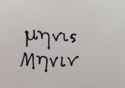
Just started learning with Pharr's Homeric Greek and have just been practicing the alphabet and learning the sounds, writing it out, writing out words etc. I am however slightly confused by picrel. In Pharr's book he has the word for wrath, the opening line of the Illiad as the top spelling ending in sigma rather than nu which with my pronunciation guide would be pronounced like S in the word "sit" in English. The bottom spelling is present in my Loeb Illiad, and makes sense to me with the nu sound being like the N in "net" in English; every time I've heard the Illiad recited the word for wrath is pronounced "ménin" not "ménis." What am I missing here?
>>
>>